
A Seoul visit for crooked-nose consultation should begin with an assessment, not a return-flight countdown. If the bridge or tip appears tilted, your first appointment needs time to explore when that changed, whether breathing is affected and what—if anything—can reasonably be treated.
This guide focuses on planning an international visit. For clinic-specific assessment information, read DI’s crooked-nose correction page. A travel coordinator can help organize questions and arrangements; only the treating clinician can establish suitability and give medical clearance.
Before travel: send a clear question, not a proposed operation
Write down what bothers you from the front and profile, when you first noticed it and whether an injury or previous nasal procedure preceded the change. Describe any blocked-nose symptoms separately. Photographs may help organize a preliminary conversation but cannot establish which nasal structures need treatment.
Ask the clinic how to share previous operative reports, implant or graft details, medications and relevant health information securely. Do not put sensitive records in a public comment. Confirm the language of the consultation and whether interpretation is available for consent and postoperative instructions—not just booking.
If you have already had rhinoplasty, explain that before scheduling. Assessment and follow-up may differ from a first procedure. Our general rhinoplasty pre-travel checklist covers additional questions, while this article concentrates on deviation and the practical space needed for an individualized plan.
Understanding crooked-nose correction
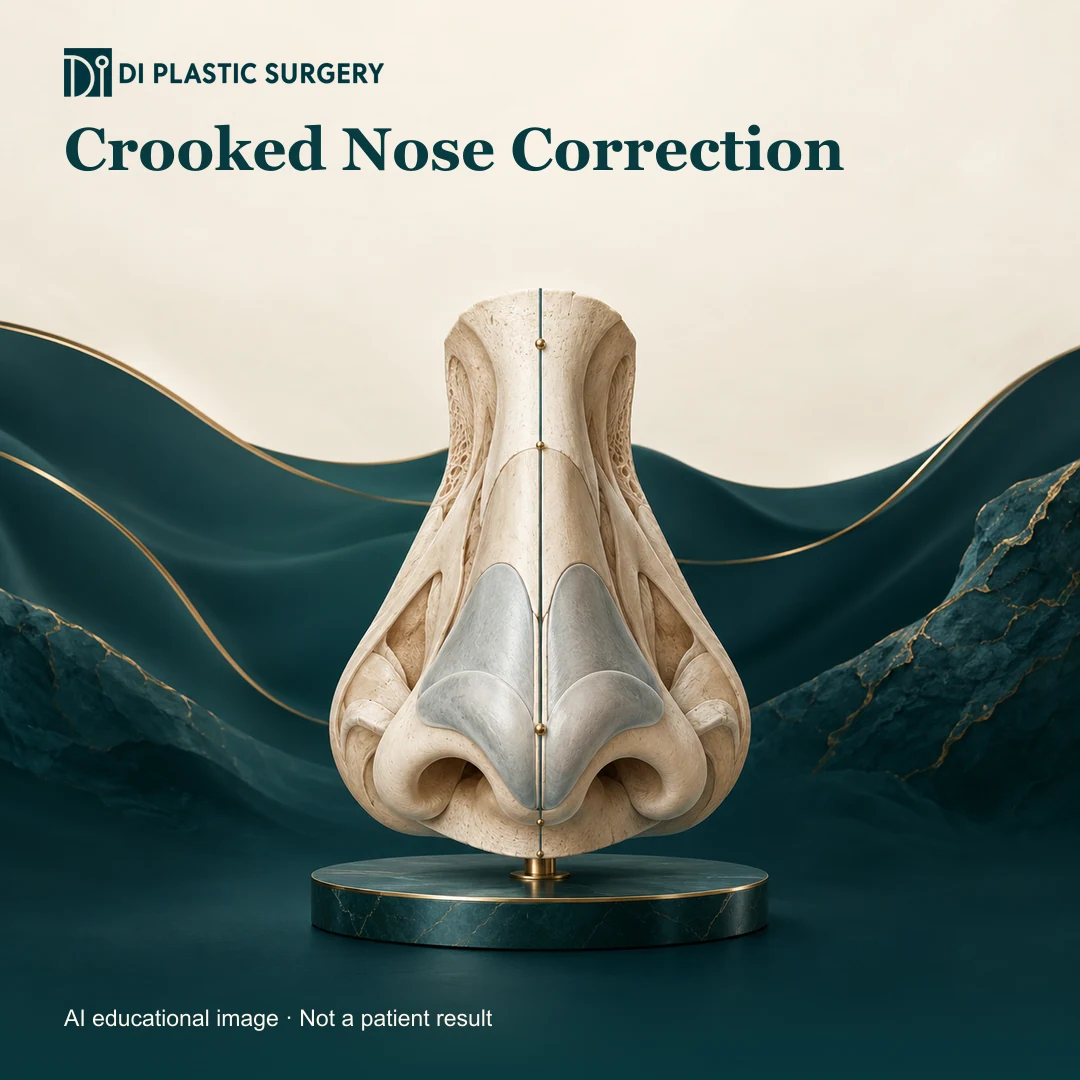
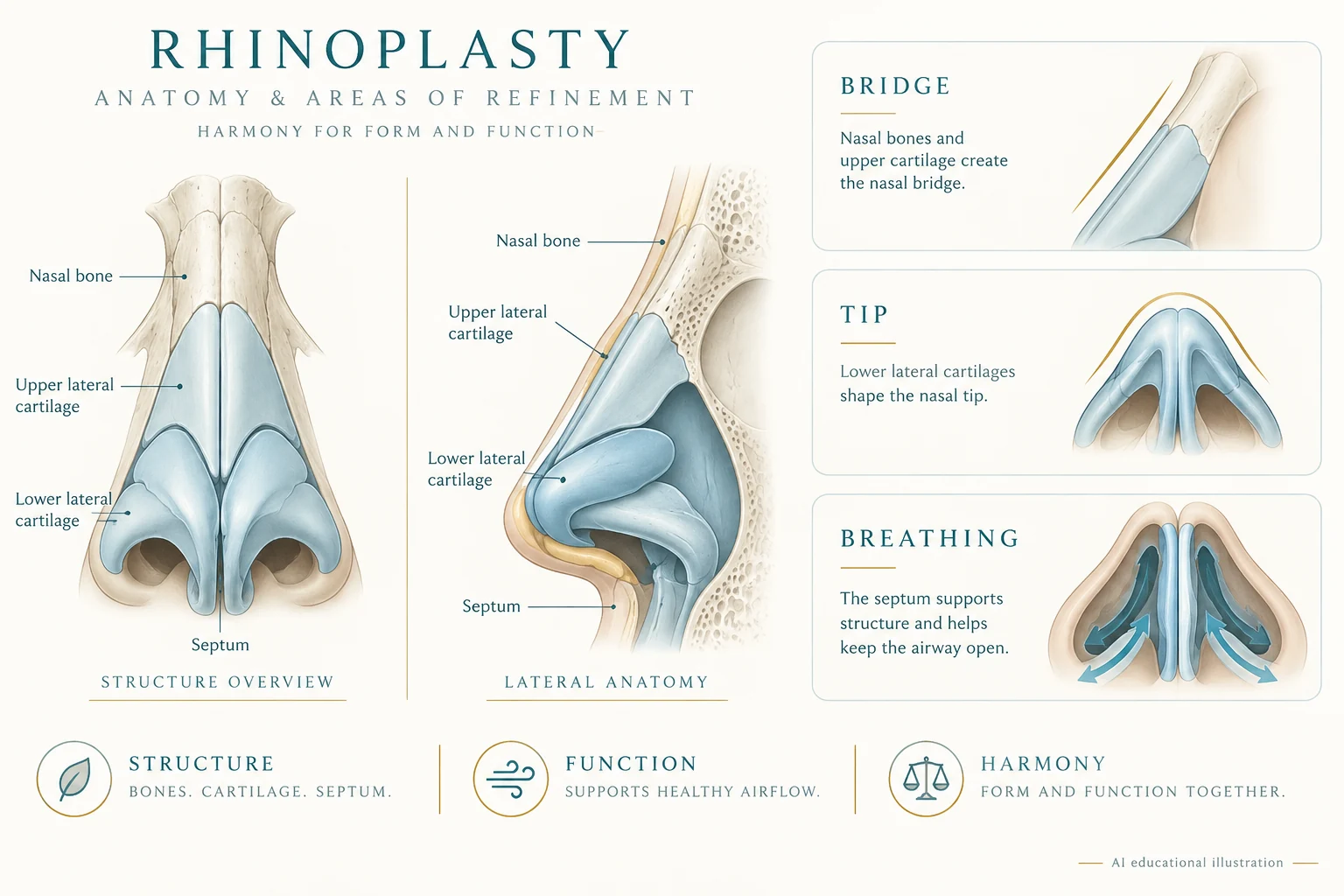
A crooked appearance may involve nasal bones, cartilage, the septum or more than one structure. Assessment considers front-view alignment, tip direction, prior injury or surgery, and breathing. Visible asymmetry does not establish which structure should be changed.
The surgeon may discuss different steps for the bony and cartilaginous portions, and whether septal work is relevant. A plan should distinguish the intended external alignment change from the treatment of diagnosed obstruction. Ask what degree of residual asymmetry is realistic.
Bring photographs taken before an injury or prior operation if available. Explain whether breathing differs between sides. The illustration is an educational schematic, not a measurement of deviation or a prediction that the nose can be made perfectly symmetrical.
Make the consultation a separate decision point
Ask how much time to reserve for examination and whether additional tests could be needed. DI’s published information discusses nasal bones, cartilage and the septum and describes structural imaging. Ask why any proposed test is needed for you; do not assume a particular scan or operation is included automatically.
Keep the option to postpone or decline treatment. Questions worth recording include: which structures contribute to the deviation, whether the appearance and breathing concerns have the same cause, what alternatives exist and what unevenness might remain. Neither an externally straight appearance nor improved breathing can be guaranteed.
Choose accommodation around return visits
Before confirming accommodation, check the clinic’s current address and the expected review appointments. The DI visit-information page provides clinic access details. Prioritize a practical route back to the clinic, a quiet place to rest and flexibility if your stay changes.
Discuss arrival transport, a companion if the care team requires one and assistance after anesthesia. Avoid building a sightseeing itinerary around an assumed recovery day. Ask about splints, glasses, activity and luggage handling instead of relying on another traveller’s experience. Your medical team’s restrictions take priority over a travel package.
What the proposed procedure should specify
Ask which structures cause the deviation, whether septal correction is included, and whether the case is primary or revision surgery.
Before consent, ask the clinician to name the operation and alternatives, explain the main objective and limitations, and confirm the person responsible for treatment and postoperative review. A schematic, a price item or a case video cannot establish suitability for an individual patient.
Verified DI price guide: KRW, VAT included
Source: DI 2026 English Price Guide, dated 11 September 2026, page 3; checked on 7 October 2026. The guide labels these as general prices in Korean won with VAT included.
These rows are different procedures, packages or add-ons. An add-on is not the full operation price. The guide’s price does not establish which anesthesia, materials, tests, medicines, aftercare or additional procedures are included in your case. Request an itemized current quote before booking.
| Verified item | KRW, VAT included | Price scope |
|---|---|---|
| Primary crooked-nose correction, including septal component | KRW 600,000 | Add-on only; not a standalone procedure price |
Budget for the plan and possible changes
Request an itemized quotation after assessment: proposed surgery, anesthesia, tests, any materials, prescribed care and follow-up. Ask how unexpected additional visits or changes to the plan are handled. Price, suitability, expected benefit and recovery depend on the individual; this article does not quote a package or promise a treatment date.
Discuss risks before making a financial commitment. Rhinoplasty can involve bleeding, infection, scarring, anesthesia complications, altered sensation, breathing difficulties, dissatisfaction and further surgery. Ask which risks are relevant to your situation and how to reach the clinic if a concern develops.
Read an early gallery photograph in context
The original DI gallery identifies Case 002 as “Dorsal hump correction · Osteotomy · Deviated-nose correction”, with photographs taken 2 weeks after surgery. This is a combined-procedure case at an early follow-up, not a final appearance, a promised recovery deadline or proof of what crooked-nose correction alone achieves.
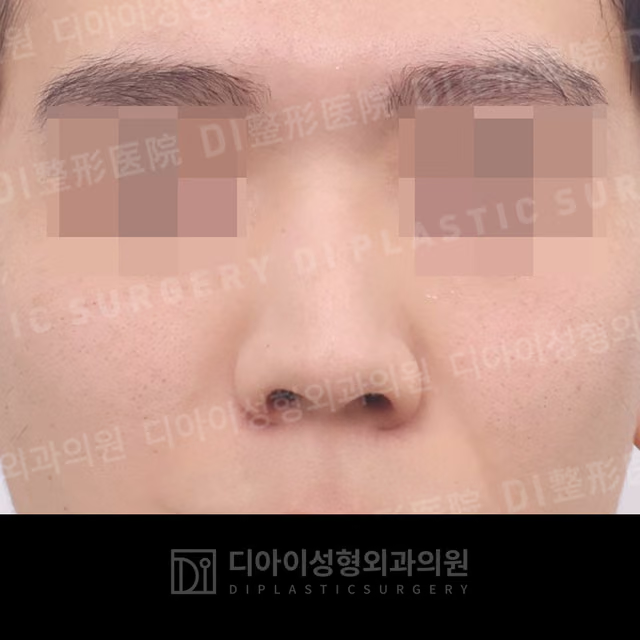
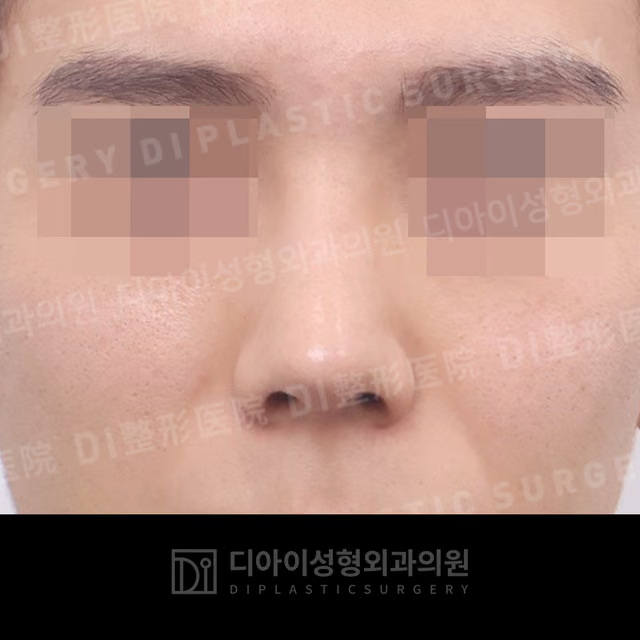
The original files and privacy masking are retained, without editing or overlays. Individual results and recovery vary. View the original DI Before & After gallery for the source and case label.
Before departure: confirm continuity of care
Do not equate an early review or suture removal with fitness to fly. Ask the surgeon to assess your actual recovery and agree on travel timing, warning signs, written aftercare and follow-up after returning home. Obtain the clinic’s contact route and know where to seek urgent medical help locally.
For the medical appointment, use DI’s consultation contact and review its medical-team profile. For non-medical visit arrangements, see what KOMD coordinates. Coordination is not medical advice or a guarantee of treatment results.
Sources and scope
- DI: crooked-nose assessment and procedure information
- American Society of Plastic Surgeons: rhinoplasty risks
- NHS: nose reshaping and recovery
Checked 1 October 2026. General planning information, not a diagnosis, personalized treatment plan or medical clearance.
Preparation, aftercare and travel milestones
Before surgery, document previous nose operations, implants or grafts, breathing symptoms and injury history. Bring operative records where available. Review medicines, allergies and smoking or nicotine use with the team, and obtain specific preparation instructions.
Confirm splint, packing and suture arrangements and how to care for them. Avoid manipulating dressings or the nose without instructions. Ask about pressure from glasses, nose blowing, sleeping position and return to exercise. Early swelling can affect the apparent bridge and tip; a day-7 or one-month image is not a final result.
Arrange travel around the clinician’s review schedule, not around a generic blog timeline. Ask what symptoms should prompt immediate contact, when flying is suitable and how subsequent follow-up will continue after returning home.

Risks and symptoms to discuss before consent
Discuss bleeding, infection, scarring, asymmetry, breathing changes, material or graft concerns and possible revision. If cartilage harvesting is planned, discuss donor-site risks separately. Unexpected severe symptoms require assessment rather than comparison with an online photograph.
Ask which risks are most relevant to your examination, how complications would be handled, and what alternatives include postponing or not having treatment. Obtain written instructions from the treating team; a general article cannot replace them.
Questions before surgery and travel
Is KRW 600,000 the whole crooked-nose operation price?
No. The guide lists it as a primary-rhinoplasty add-on. The base operation and any other required steps must be quoted separately.
Who confirms my final treatment plan and quotation?
The treating medical institution confirms suitability, the procedure, consent and the current itemized medical quotation. KOMD helps coordinate information and travel arrangements.
Does an early recovery estimate mean that I can fly?
No. Required reviews, wound or suture care and individual travel clearance must be confirmed by the treating clinician.
Procedure explanations and educational illustrations updated 7 October 2026. DI procedure information. Illustrations are AI-generated concepts, not actual patients or results. Medical decisions and current fees require clinic confirmation.