
Before committing to a rhinoplasty trip to Seoul, organize a consultation that can answer three separate questions: what you want to discuss about your nose, what an examination can establish, and what travel arrangements would remain practical if the plan changes. A preliminary photograph inquiry can help start that conversation, but it is not a confirmed operation, an assessment of all internal structures or a promise of a particular result.
Prepare a nose-specific consultation brief
Instead of asking only for a higher bridge or a different tip, write down the concern you want the surgeon to assess. Describe any breathing symptoms separately from appearance goals. Include previous nasal surgery, injury or treatment and the approximate dates, without deciding for yourself which operation is required.
DI’s rhinoplasty overview discusses front and side assessment, the nasal bridge and tip, and the relationship with neighboring facial features. Use those topics to organize questions. A photograph of someone else’s nose may explain a preference, but cannot establish that the same design is feasible for you.
Understanding rhinoplasty
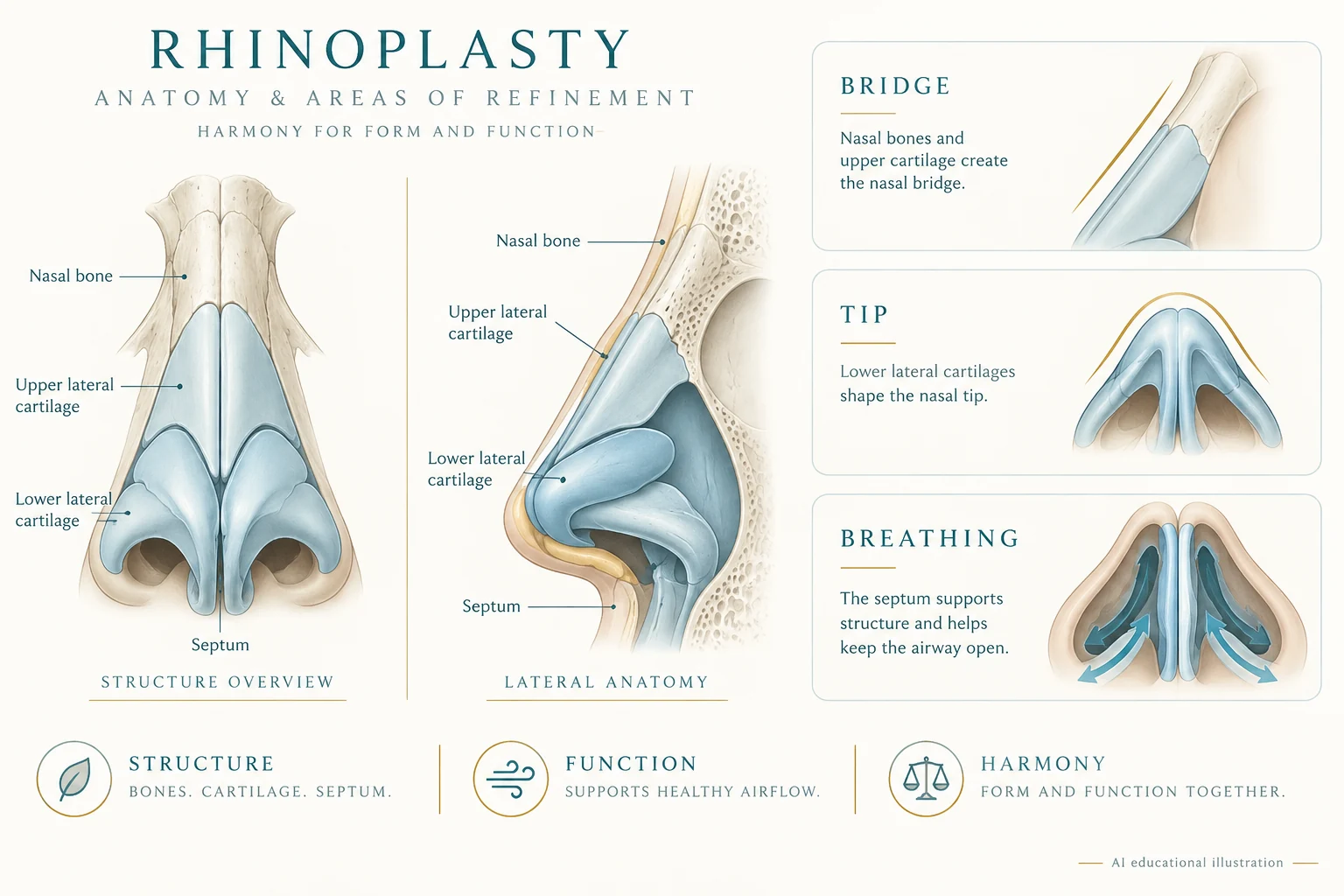
Rhinoplasty can change the nasal bridge, tip or other selected structures. The nose contains bone, cartilage and a skin envelope, and the planned changes must be considered together with breathing and facial proportions. A front photograph and a profile show different information; neither replaces examination.
A plan may discuss bridge augmentation or reduction, tip support, graft materials, and open or closed access. Those terms describe choices, not a single standard recipe. Ask which steps are actually needed and whether a functional component is being proposed in addition to cosmetic changes.
The illustration separates the bridge, tip-support structures and airway. The arrows describe relationships rather than a guaranteed operation or result. Changing one area can affect the balance of another; the consent discussion should explain both the intended changes and the features that will be left alone.
Gather records before an appointment is confirmed
The American Society of Plastic Surgeons lists goals, medical conditions, allergies, medications and previous operations as consultation topics. Make an accurate summary and ask the clinic which records are useful. If you have had nasal surgery, request any available operative information from the treating provider rather than relying on memory of an implant or graft name.
Ask how documents and photographs should be sent securely, which language the clinician can review, and whether translation is needed. Do not change medication or arrange a new scan on the basis of a travel guide. The treating team should specify what examinations are appropriate.
Ask what is provisional and what requires an examination
A useful preliminary reply should make its limits clear. Ask which suggestions remain provisional until the surgeon examines you, whether breathing concerns need a separate functional assessment, and which findings could change the recommendation. Your travel plan should allow for a decision not to operate.
- Which parts of my concern can be discussed from photographs, and which cannot?
- What is the proposed purpose of each component of surgery?
- If a graft or implant is proposed, why is that material being considered, and what are its alternatives and limitations?
- If my own cartilage is discussed, would a donor area need separate care?
- What would happen if the examination changes the plan or surgery is deferred?
For narrower questions, read our functional rhinoplasty travel guide or rib-cartilage consultation planning guide. Neither implies that you need those procedures.

What the proposed procedure should specify
Request the proposed bridge and tip steps, material names, breathing assessment, incision approach, anesthesia and itemized costs in writing.
Before consent, ask the clinician to name the operation and alternatives, explain the main objective and limitations, and confirm the person responsible for treatment and postoperative review. A schematic, a price item or a case video cannot establish suitability for an individual patient.
Verified DI price guide: KRW, VAT included
Source: DI 2026 English Price Guide, dated 11 September 2026, page 3; checked on 7 October 2026. The guide labels these as general prices in Korean won with VAT included.
These rows are different procedures, packages or add-ons. An add-on is not the full operation price. The guide’s price does not establish which anesthesia, materials, tests, medicines, aftercare or additional procedures are included in your case. Request an itemized current quote before booking.
| Verified item | KRW, VAT included | Price scope |
|---|---|---|
| Nasal bridge augmentation + tip surgery | KRW 2,800,000 | Listed procedure fee |
Build a conditional itinerary and budget
Separate the dates for consultation, any further assessment, possible treatment and postoperative reviews. Ask which appointments require you to remain in Seoul, how return-to-flight advice will be decided, and what arrangements apply if recovery requires additional review. There is no universal flight-home day for rhinoplasty.
Before paying for non-refundable travel, obtain written information about the appointment, cancellation conditions and proposed fees. Ask what the quotation includes: assessment, anesthesia if relevant, the proposed procedure and scheduled reviews. Clarify how additional treatment or a longer stay would be handled. Suitability, results, price and recovery require individual assessment.
Confirm language support for consent and postoperative instructions, transport needs after treatment and a contact route for questions. Travel coordination can help organize logistics but cannot replace the treating surgeon’s assessment or decide when you are fit to fly.
Read a verified result photograph in its proper context
DI’s designated gallery identifies case 719 as rhinoplasty with own rib cartilage, with photographs labeled 1 month after surgery. The original front-view pair is reproduced unchanged below. It is an example of that stated procedure, not evidence that rib cartilage is necessary for your case or preferable to every alternative.
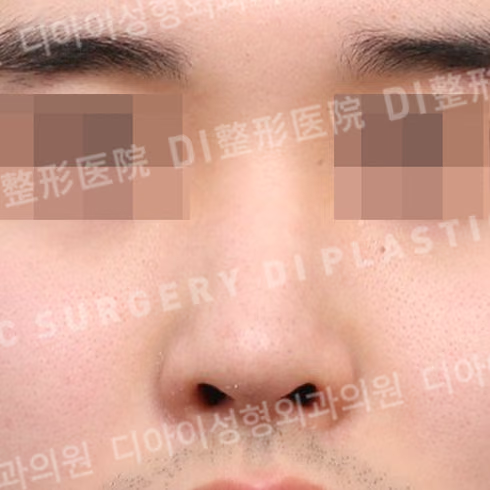
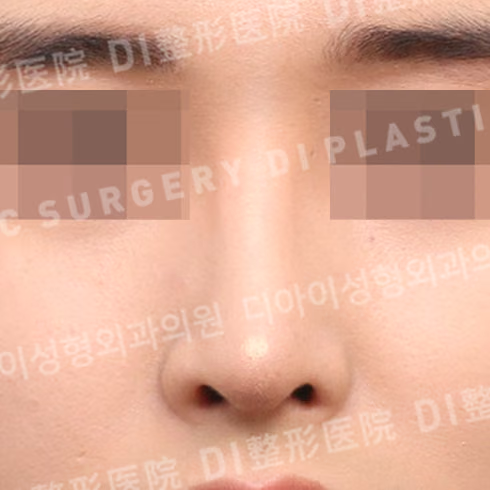
Results vary. A one-month photograph is not a guaranteed final outcome or a recovery deadline. Find “case-719” in the original DI gallery to check the displayed procedure and timing. These two original photographs remain hosted by DI; KOMD hosts the three editorial illustrations.
Request a risk discussion and a follow-up contact plan
Ask about anesthesia risks, infection, changes in sensation, breathing difficulties, scarring, dissatisfaction with appearance and the possibility of further surgery. The surgeon should explain the risks relevant to the proposed procedure and your health. Ask which symptoms require urgent assessment and how to obtain emergency care locally or after returning home.
For recovery expectations, our rhinoplasty follow-up guide explains why an early photograph cannot settle the whole recovery story. For a clinic inquiry, review DI’s medical-team information and consultation process. A consultation is a decision-making step, not a commitment to surgery.
Sources and scope
- DI Rhinoplasty overview — clinic assessment topics.
- DI Before & After gallery — case 719, displayed procedure and 1-month follow-up.
- ASPS: rhinoplasty consultation — consultation preparation.
- ASPS: rhinoplasty safety — general risk discussion.
Checked on 1 October 2026. General educational and travel-planning information, not personalized medical advice. AI-generated editorial images do not show actual treatment results.
Preparation, aftercare and travel milestones
Before surgery, document previous nose operations, implants or grafts, breathing symptoms and injury history. Bring operative records where available. Review medicines, allergies and smoking or nicotine use with the team, and obtain specific preparation instructions.
Confirm splint, packing and suture arrangements and how to care for them. Avoid manipulating dressings or the nose without instructions. Ask about pressure from glasses, nose blowing, sleeping position and return to exercise. Early swelling can affect the apparent bridge and tip; a day-7 or one-month image is not a final result.
Arrange travel around the clinician’s review schedule, not around a generic blog timeline. Ask what symptoms should prompt immediate contact, when flying is suitable and how subsequent follow-up will continue after returning home.

Risks and symptoms to discuss before consent
Discuss bleeding, infection, scarring, asymmetry, breathing changes, material or graft concerns and possible revision. If cartilage harvesting is planned, discuss donor-site risks separately. Unexpected severe symptoms require assessment rather than comparison with an online photograph.
Ask which risks are most relevant to your examination, how complications would be handled, and what alternatives include postponing or not having treatment. Obtain written instructions from the treating team; a general article cannot replace them.
Questions before surgery and travel
Does the bridge-and-tip fee cover every form of rhinoplasty?
No. It is the price for that named line item. Revision, rib cartilage, functional work and other additions can have separate fees.
Who confirms my final treatment plan and quotation?
The treating medical institution confirms suitability, the procedure, consent and the current itemized medical quotation. KOMD helps coordinate information and travel arrangements.
Does an early recovery estimate mean that I can fly?
No. Required reviews, wound or suture care and individual travel clearance must be confirmed by the treating clinician.
Procedure explanations and educational illustrations updated 7 October 2026. DI procedure information. Illustrations are AI-generated concepts, not actual patients or results. Medical decisions and current fees require clinic confirmation.