
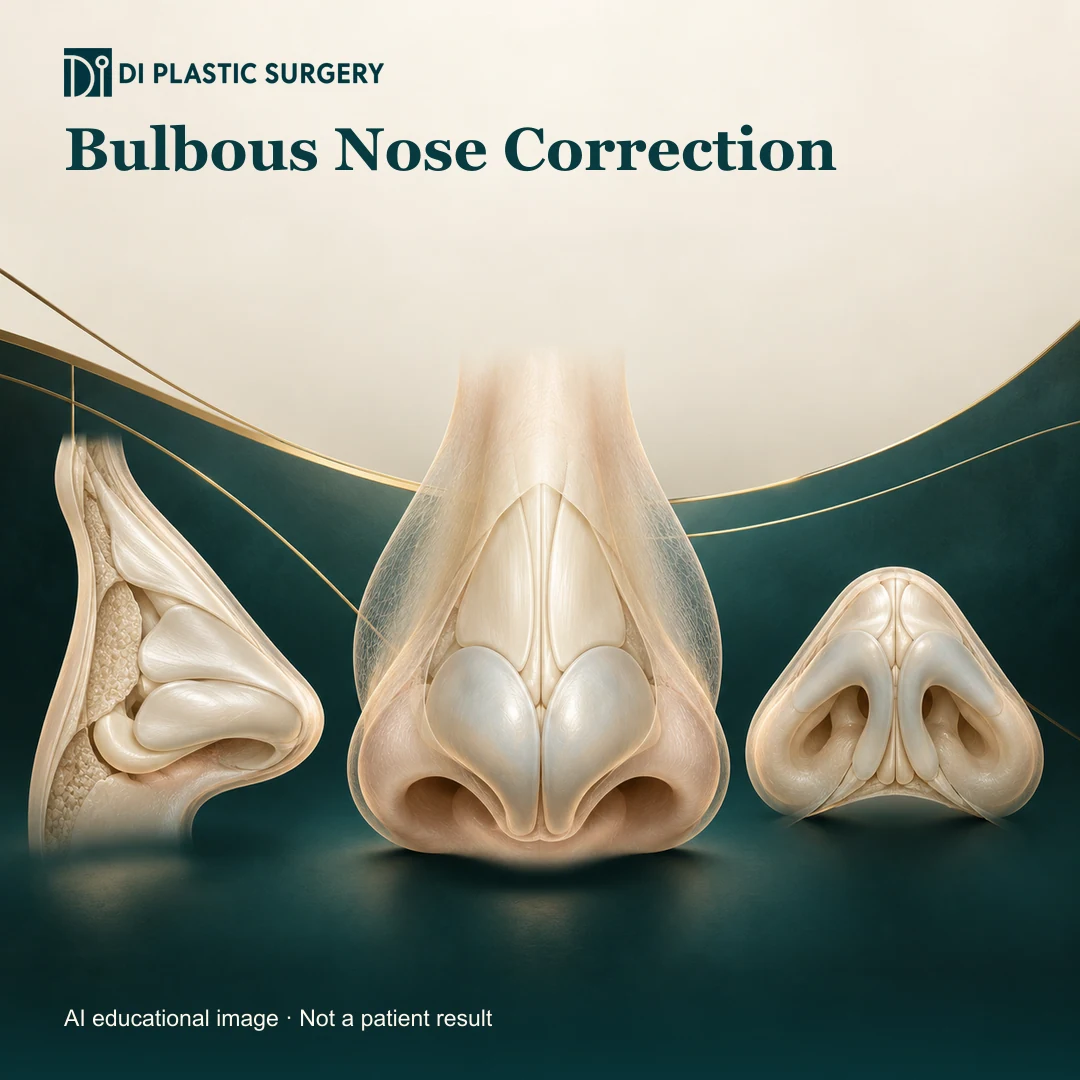
If your main concern is a broad or rounded nasal tip, a Seoul trip should give you space to understand the assessment before deciding on treatment. A photograph and the label “bulbous nose” are not enough to select an operation, a graft or a return-flight date.
This guide is for an international visitor preparing a bulbous-nose consultation at DI. It covers records, communication and practical arrangements. A travel coordinator cannot diagnose your nose or provide medical clearance.
Prepare a short explanation of your tip concern
Describe what you notice from the front and side and whether the concern has changed over time. Distinguish tip width, bridge height and breathing symptoms instead of combining them into a request for a “smaller nose”. Tell the clinic about previous surgery, implants, fillers, nasal threads or injury before discussing appointment dates.
Ask how to send any requested photographs or records securely. Do not post medical documents in a public comment or include passport and payment details in an initial inquiry. An online discussion can help prepare an appointment; it cannot confirm a technique or guarantee suitability.
Understanding bulbous-nose correction
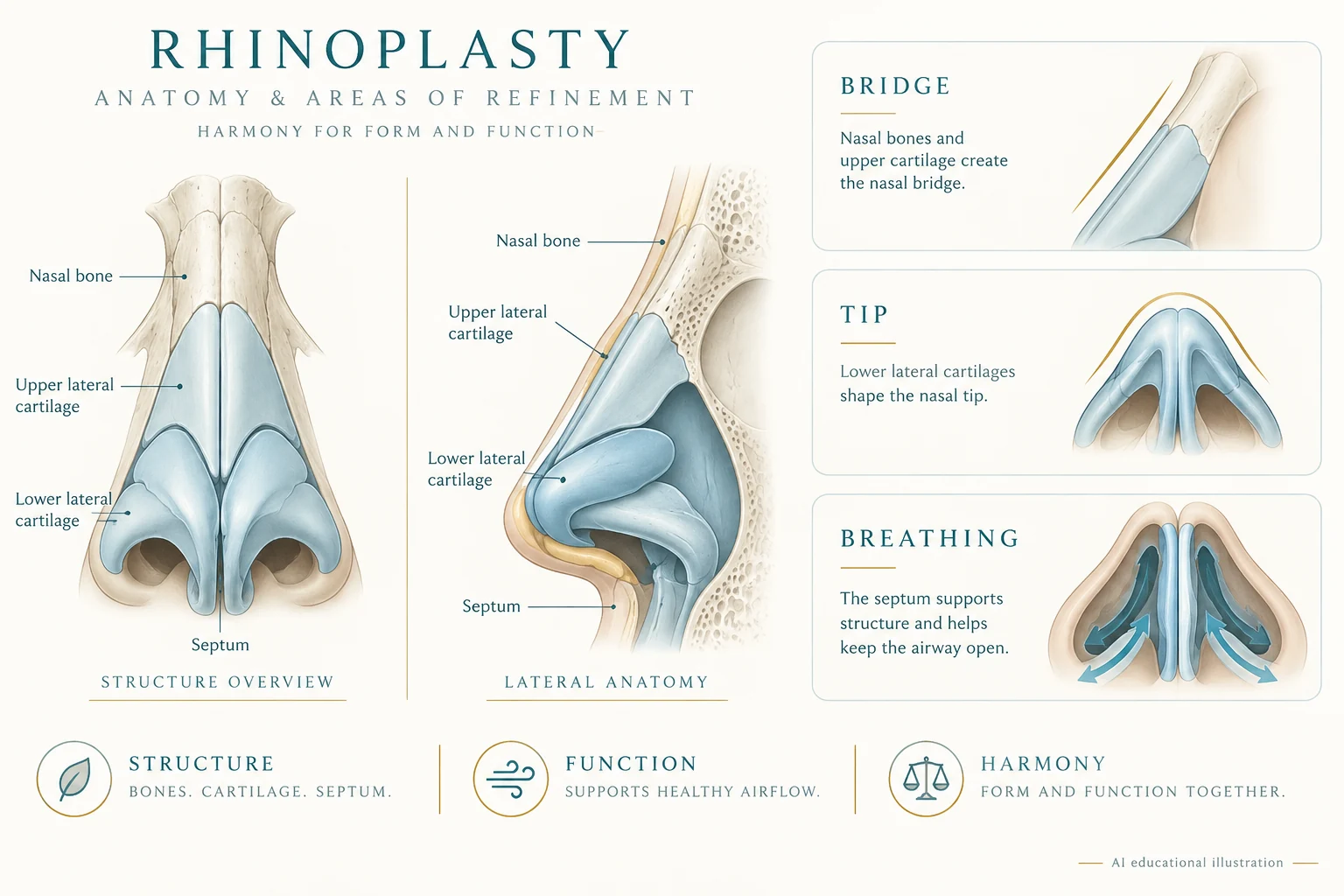
A broad or rounded tip can reflect cartilage shape, supporting structures and the thickness of the skin envelope. These factors need assessment together; the external photograph does not show how much of the contour is caused by each tissue.
Tip refinement may involve reshaping or supporting selected cartilage. The plan should explain the intended change, grafts if any, and the limits imposed by the skin and existing structures. A narrower-looking reference tip cannot be promised for a different nose.
Discuss tip projection, rotation, front-view symmetry and breathing. The tip-support illustration separates structural support from surface appearance; it does not imply that thinning skin or removing a large amount of cartilage is the appropriate method.
Confirm that the consultation can answer your questions
Ask who will examine you, the language of the appointment and how interpretation works for consent and aftercare. Review the DI medical-team profile beforehand. Prepare a medication and supplement list, allergies and relevant health history, and disclose nicotine use.
Questions specific to a rounded tip include: What contributes to the appearance in my case? How do skin, soft tissue and cartilage affect what is possible? What support must be preserved? If a graft or another procedure is suggested, why is it relevant? DI’s page describes several possible approaches; those descriptions do not make every approach necessary for every visitor.
Use the general rhinoplasty pre-travel guide for broader preparation. This visit should focus on your tip concern, without treating bridge augmentation or additional surgery as an automatic package.
Reserve time to decide, not just time to operate
Separate the assessment from the commitment to surgery. Ask whether examination, additional testing or another discussion is needed before a final plan and quotation. Keep the option to postpone or decline treatment if the proposed change, risks or follow-up do not suit you.
Request a written estimate based on the clinician’s actual plan. Clarify anesthesia, tests, any graft or donor-site care, routine reviews and possible additional costs. Suitability, effect, price and recovery depend on individual assessment. There is no universal package or stay length established by this article.
What the proposed procedure should specify
Ask which tissue contributes to the broad appearance, how tip support will be preserved, and which graft or additional procedures are actually required.
Before consent, ask the clinician to name the operation and alternatives, explain the main objective and limitations, and confirm the person responsible for treatment and postoperative review. A schematic, a price item or a case video cannot establish suitability for an individual patient.
Verified DI price guide: KRW, VAT included
Source: DI 2026 English Price Guide, dated 11 September 2026, page 3; checked on 7 October 2026. The guide labels these as general prices in Korean won with VAT included.
These rows are different procedures, packages or add-ons. An add-on is not the full operation price. The guide’s price does not establish which anesthesia, materials, tests, medicines, aftercare or additional procedures are included in your case. Request an itemized current quote before booking.
| Verified item | KRW, VAT included | Price scope |
|---|---|---|
| Primary bulbous-tip correction | KRW 400,000 | Add-on only; not a standalone procedure price |
Choose practical accommodation and flexible travel
Confirm the current clinic address and appointment times using DI’s visit information. Choose accommodation with an easy route back for reviews and flexible extension terms. Ask about transport and an accompanying adult if the medical team requires one after anesthesia.
Discuss glasses, activity, luggage handling and any donor-site restrictions with the treating team if surgery is planned. Do not schedule strenuous sightseeing around a generic recovery day. Obtain the expected review schedule before buying a fixed return flight; an early photograph or suture removal does not itself establish fitness to fly.
Read the original case as an individual follow-up
DI’s designated gallery identifies Case 063 as “Bulbous-nose correction”, with front-view photographs taken 1 month after surgery. The label does not identify the exact technique or graft material. The pair below remains unedited, with the original privacy masking; it is not a prediction or evidence that one method suits every rounded tip.
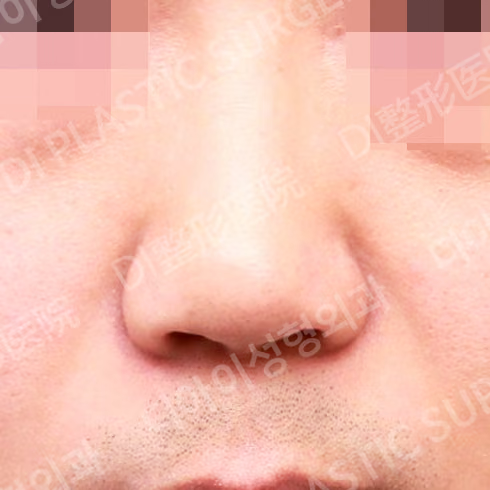
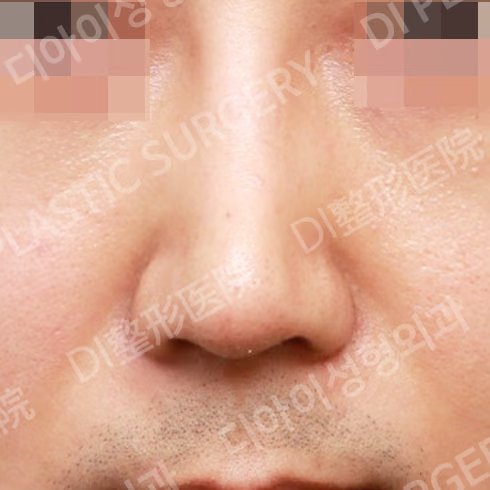
Results and recovery vary, and one month is not a guaranteed final appearance. See the original DI Before & After gallery for the source and case label.
Arrange continuity of care before returning home
Rhinoplasty risks include bleeding, infection, scarring, anesthesia complications, changes in sensation, breathing difficulties, an unsatisfactory appearance and further surgery. Discuss the risks relevant to your proposed treatment and ask how unexpected concerns are handled.
Obtain written aftercare, warning signs, a clinic contact route and the follow-up arrangement after departure. The treating surgeon should assess travel readiness, and urgent symptoms require appropriate in-person medical care. Use DI’s consultation contact for medical questions and KOMD’s coordination information for non-medical visit arrangements. Coordination is not a guarantee of treatment results.
Sources and scope
- DI: bulbous-nose procedure information
- American Society of Plastic Surgeons: consultation
- American Society of Plastic Surgeons: risks
- NHS: rhinoplasty and recovery
Checked 1 October 2026. General preparation information, not a diagnosis, personal treatment plan or medical clearance.
Preparation, aftercare and travel milestones
Before surgery, document previous nose operations, implants or grafts, breathing symptoms and injury history. Bring operative records where available. Review medicines, allergies and smoking or nicotine use with the team, and obtain specific preparation instructions.
Confirm splint, packing and suture arrangements and how to care for them. Avoid manipulating dressings or the nose without instructions. Ask about pressure from glasses, nose blowing, sleeping position and return to exercise. Early swelling can affect the apparent bridge and tip; a day-7 or one-month image is not a final result.
Arrange travel around the clinician’s review schedule, not around a generic blog timeline. Ask what symptoms should prompt immediate contact, when flying is suitable and how subsequent follow-up will continue after returning home.

Risks and symptoms to discuss before consent
Discuss bleeding, infection, scarring, asymmetry, breathing changes, material or graft concerns and possible revision. If cartilage harvesting is planned, discuss donor-site risks separately. Unexpected severe symptoms require assessment rather than comparison with an online photograph.
Ask which risks are most relevant to your examination, how complications would be handled, and what alternatives include postponing or not having treatment. Obtain written instructions from the treating team; a general article cannot replace them.
Questions before surgery and travel
Is the verified tip-correction amount a complete rhinoplasty price?
No. KRW 400,000 is an add-on in the primary-surgery section of the guide. Confirm the base operation and material charges.
Who confirms my final treatment plan and quotation?
The treating medical institution confirms suitability, the procedure, consent and the current itemized medical quotation. KOMD helps coordinate information and travel arrangements.
Does an early recovery estimate mean that I can fly?
No. Required reviews, wound or suture care and individual travel clearance must be confirmed by the treating clinician.
Procedure explanations and educational illustrations updated 7 October 2026. DI procedure information. Illustrations are AI-generated concepts, not actual patients or results. Medical decisions and current fees require clinic confirmation.