
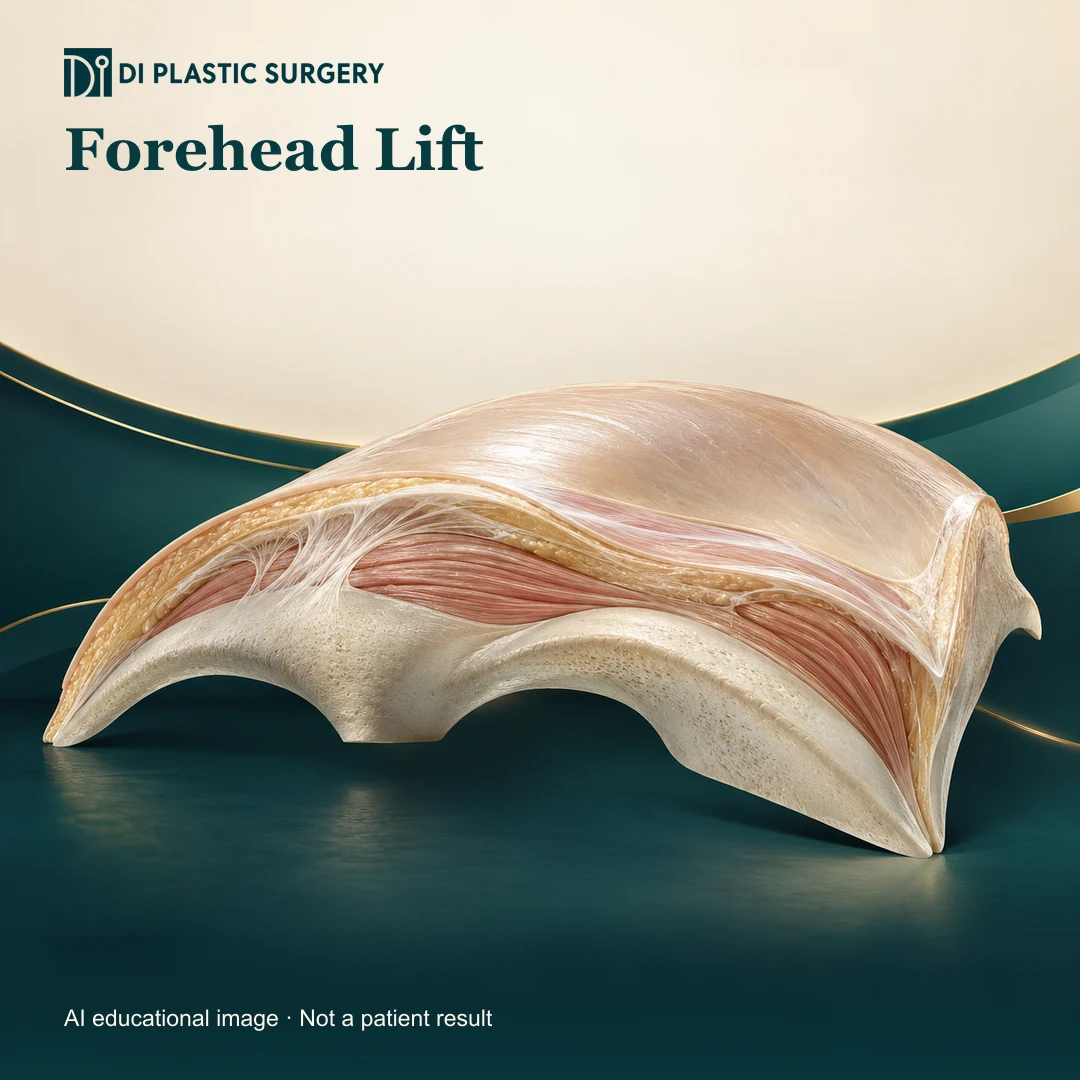
Planning a forehead-lift visit to Seoul starts with separating the consultation from the operation and the operation from your departure date. This guide helps an overseas visitor prepare those decisions. It does not prescribe a stay length or promise a result.
The cover and planning illustrations are AI-generated. They are not photographs of a patient, treatment outcome, treating doctor or a recommended hotel.
Make the first appointment a decision point
Tell the clinic what you notice about your brow, forehead or upper-eye area and which features you want to preserve. Ask what can be assessed remotely and what requires examination. A forehead lift, sub-brow lift and an eyelid operation are different discussions; a coordinator cannot establish suitability from a travel inquiry.
Share tentative dates, your preferred consultation language and whether the trip is for consultation only or whether you are considering surgery if it is recommended. Keep enough flexibility for a different plan, further assessment or no operation. Read DI’s forehead-lift overview for clinic-specific background, and review KOMD’s procedure directory without treating a listing as a personal recommendation.
Understanding forehead lift
A forehead lift considers brow position and the forehead tissues. Brow descent can contribute to upper-eyelid heaviness, but it differs from excess lid skin or a low eyelid margin. Those concerns should be assessed separately.
The surgeon discusses the intended brow position, incision route and how the hairline may be affected. A forehead lift is not the same as forehead reduction, which concerns hairline position and forehead height.
Ask about brow asymmetry, scalp sensation, scar location and possible effects on hair near the incision. A tissue-lifting illustration explains the general direction of support but does not establish the appropriate brow height.
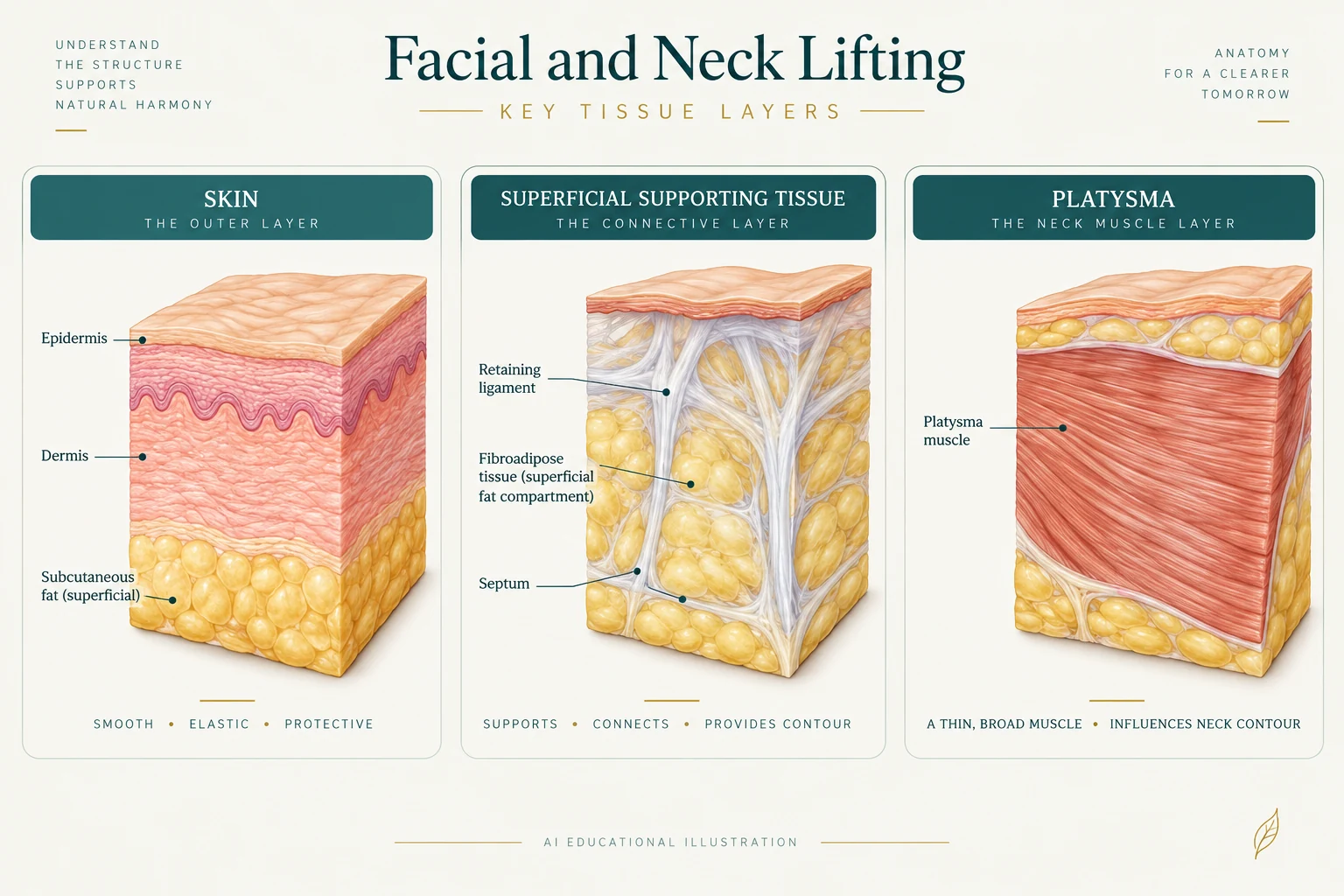
Ask for the appointment sequence before booking a return
Request a written sequence covering assessment, any preoperative checks, the procedure if chosen, early review and removal of sutures or clips if applicable. Confirm which visits are essential in person and who will advise on departure. Do not convert an online appointment count or an early patient photograph into a minimum safe stay.
A convenient flight is not medical clearance. Ask what would happen if healing is slower than expected or an extra review is needed. Check change conditions for accommodation and return travel, and keep an emergency budget rather than paying for a rigid package first.

Choose accommodation for practical care, not an advertised recovery deadline
Ask the clinic how the proposed dressing and wound-care arrangements could affect ordinary activities. When comparing rooms, consider the travel route to the clinic, elevator access, a place to rest and how a companion could help with meals and local errands if the team recommends support.
Clarify hair washing, sleeping position, head movement and activity with the treating team before planning your daily routine. Do not assume you can use a salon, sauna, gym or a particular compress method on a fixed day. DI’s general page and ASPS describe different compress advice; request a clear written answer for your operation rather than combining instructions from websites.
What the proposed procedure should specify
Clarify whether the objective is brow elevation, hairline change or both, and which separate procedures and fees apply.
Before consent, ask the clinician to name the operation and alternatives, explain the main objective and limitations, and confirm the person responsible for treatment and postoperative review. A schematic, a price item or a case video cannot establish suitability for an individual patient.
Verified DI price guide: KRW, VAT included
Source: DI 2026 English Price Guide, dated 11 September 2026, page 5; checked on 7 October 2026. The guide labels these as general prices in Korean won with VAT included.
These rows are different procedures, packages or add-ons. An add-on is not the full operation price. The guide’s price does not establish which anesthesia, materials, tests, medicines, aftercare or additional procedures are included in your case. Request an itemized current quote before booking.
| Verified item | KRW, VAT included | Price scope |
|---|---|---|
| Forehead lift | KRW 2,500,000 | Listed procedure fee |
Arrange local journeys around the clinic’s instructions
Confirm the clinic address and arrival instructions, then plan a simple route between your room and appointments. Ask whether a companion or escort is needed after sedation or anesthesia and how you should travel that day. Do not plan to drive yourself without the team’s approval.
Leave major sightseeing and tight multi-city transfers flexible. A trip can be consultation-only; surgery should remain a separate informed decision. Your airline’s rules and your clinician’s advice also need checking independently.
Know whom to contact away from the clinic
Before treatment, save the daytime and out-of-hours clinical contact, the symptoms that require prompt assessment and the arrangements for help after returning home. Discuss your medical history and the possible risks, including bleeding, infection, changes in sensation, scarring, hairline changes, eye irritation, nerve injury and anesthesia complications. This is not a complete risk list.
Ask how to obtain help if you cannot reach the clinic, and how records or instructions can be supplied in a language you understand. Travel-insurance coverage for elective treatment and complications varies; check your actual policy rather than assuming ordinary travel cover applies.
What an early gallery photograph does—and does not—tell you
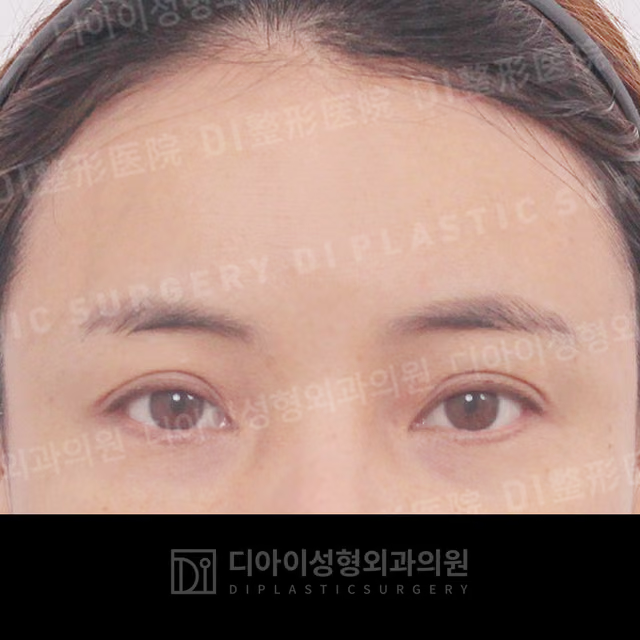
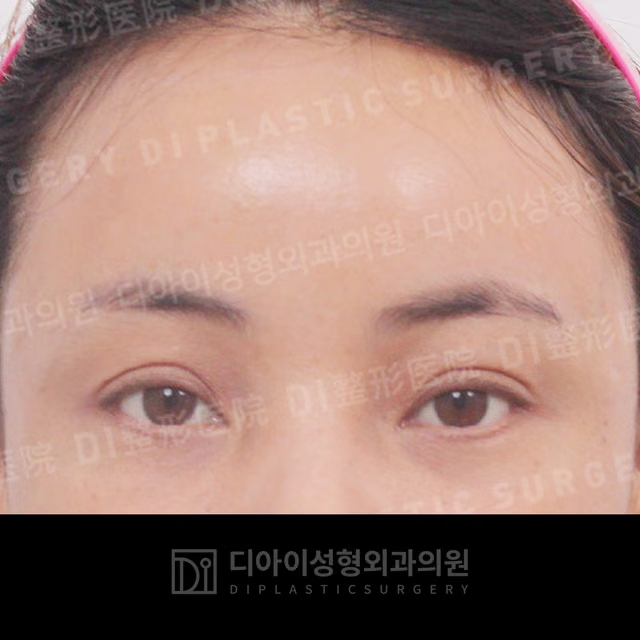
DI’s designated gallery labels case 035 as Forehead lift, front view, 10 days after surgery. The same original pair appears below without added logos, text overlays, AI retouching or a result-distorting crop. Existing original markings are retained. The gallery does not establish the calendar date or the full operative technique.
This is an early follow-up, not a final outcome, travel clearance or evidence that everyone can leave Seoul after ten days. Individual results and recovery vary. A photograph cannot describe all symptoms, complications or later changes.
Before
After
Send a focused inquiry, then build the itinerary
For the initial conversation, provide your concern, preferred language, relevant previous procedures and a tentative date range. Avoid sending passport details or complete medical records in a general travel inquiry. The clinic can explain which information is needed and how to share it.
Request an itemized estimate and identify which clinical reviews, medicines and other services are included. Compare this with accommodation, transport, companion support and flexibility costs. Suitability, effects, price and recovery require individual assessment. Use DI’s consultation routes for the clinical discussion; KOMD’s journal provides separate travel-planning context.
Sources
- DI: forehead-lift technique overview and general care guidance
- DI: medical team
- DI: original case 035, checked October 3, 2026
- ASPS: consultation
- ASPS: risks and safety
- ASPS: individualized recovery guidance
Preparation, aftercare and travel milestones
Before treatment, review previous lifting, threads, fillers or surgery, medicines, allergies and smoking or nicotine use. Ask who performs the procedure, how anesthesia is assessed and what monitoring is planned. Confirm each combined procedure separately.
Get written instructions on dressings, drains if used, wound care, hair washing, compression if prescribed and activity. Ask about expected swelling and when a rapidly increasing swelling, severe pain or other unexpected change needs immediate review. Suture removal and return to normal activity are separate milestones.
Build your stay around wound reviews and the surgeon’s assessment of recovery. Confirm how to contact the clinic after hours and after returning home. A limited-incision operation or a short procedure does not establish a fixed safe flight date.

Risks and symptoms to discuss before consent
Discuss bleeding or hematoma, infection, scarring, asymmetry, sensation changes, nerve-related complications and possible revision. Thread procedures also require discussion of visible or palpable threads, dimpling and removal. Risks vary with the operation actually proposed.
Ask which risks are most relevant to your examination, how complications would be handled, and what alternatives include postponing or not having treatment. Obtain written instructions from the treating team; a general article cannot replace them.
Questions before surgery and travel
Does a forehead lift automatically shorten the forehead?
No. Brow elevation and hairline advancement are different objectives. Any combined plan must be explained explicitly.
Who confirms my final treatment plan and quotation?
The treating medical institution confirms suitability, the procedure, consent and the current itemized medical quotation. KOMD helps coordinate information and travel arrangements.
Does an early recovery estimate mean that I can fly?
No. Required reviews, wound or suture care and individual travel clearance must be confirmed by the treating clinician.
Procedure explanations and educational illustrations updated 7 October 2026. DI procedure information. Illustrations are AI-generated concepts, not actual patients or results. Medical decisions and current fees require clinic confirmation.