
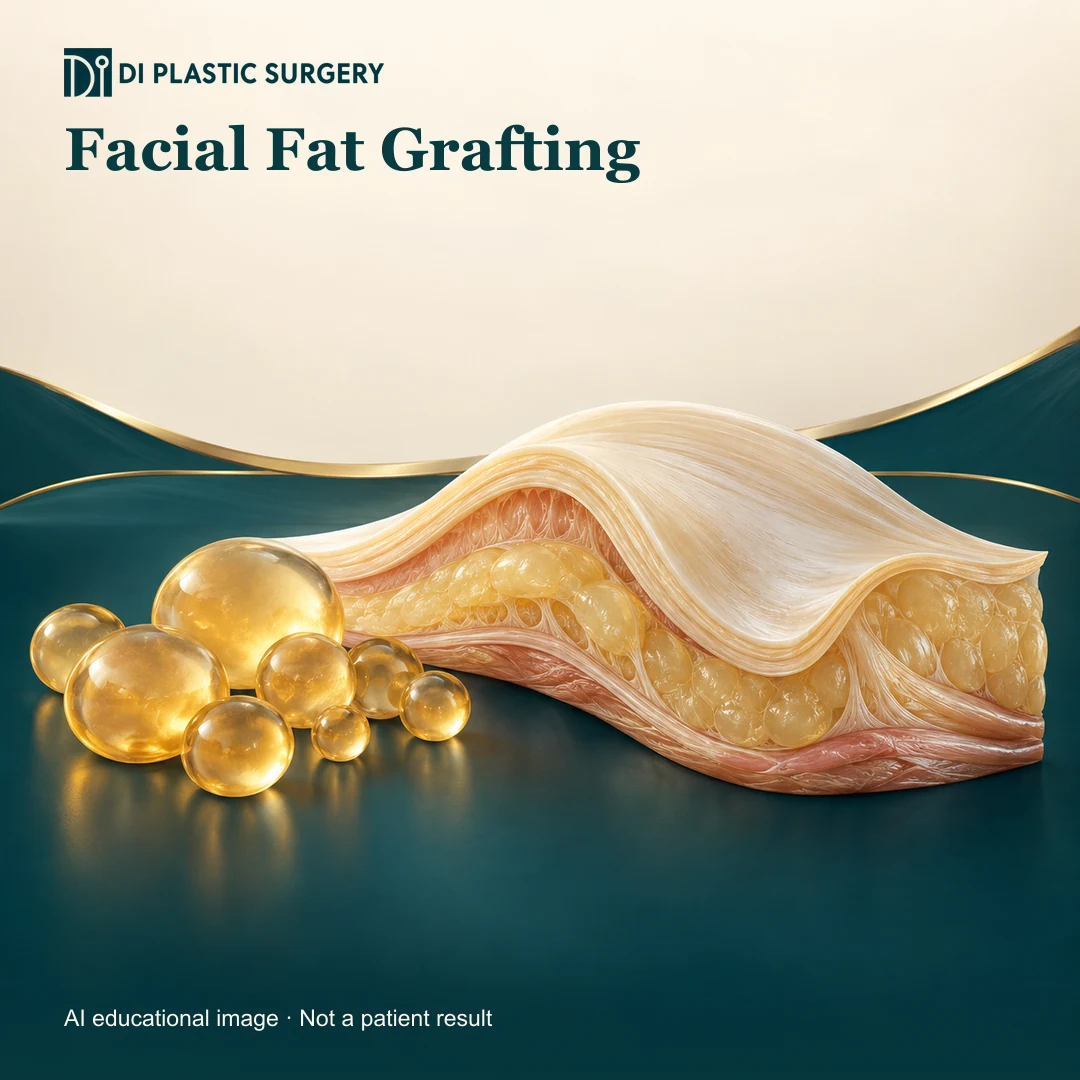
Planning a Seoul visit for facial fat grafting means arranging care for both the face and the area where fat is collected. Before you decide on flights or a hotel, ask for an assessment and a practical follow-up plan. A procedure estimate is not a reliable way to calculate your stay.
First confirm which procedure you are discussing
Facial fat grafting transfers a person’s own fat from a donor area to the face. It is not the same as under-eye fat repositioning, and harvesting tissue for transfer is not automatically a body-contouring treatment. Confirm the procedure name and proposed areas rather than booking a trip around a broad “facial rejuvenation” package.
DI lists this procedure in its official Fat Grafting overview. Use that page to prepare questions, not to diagnose your concern from a photograph. If your research began with eye bags, KOMD’s separate under-eye fat repositioning travel guide explains a different planning topic.
Understanding facial fat grafting
Facial fat grafting transfers selected fat from a donor area to a facial area where volume is being considered. Harvesting and graft placement are separate parts of the procedure. Adding volume is different from lifting descended tissue or removing unwanted fat.
The plan identifies the donor site, recipient areas and the goal in each area. Graft survival and the settled contour vary, so a fixed retained-volume percentage or a guaranteed one-session result should not be promised.
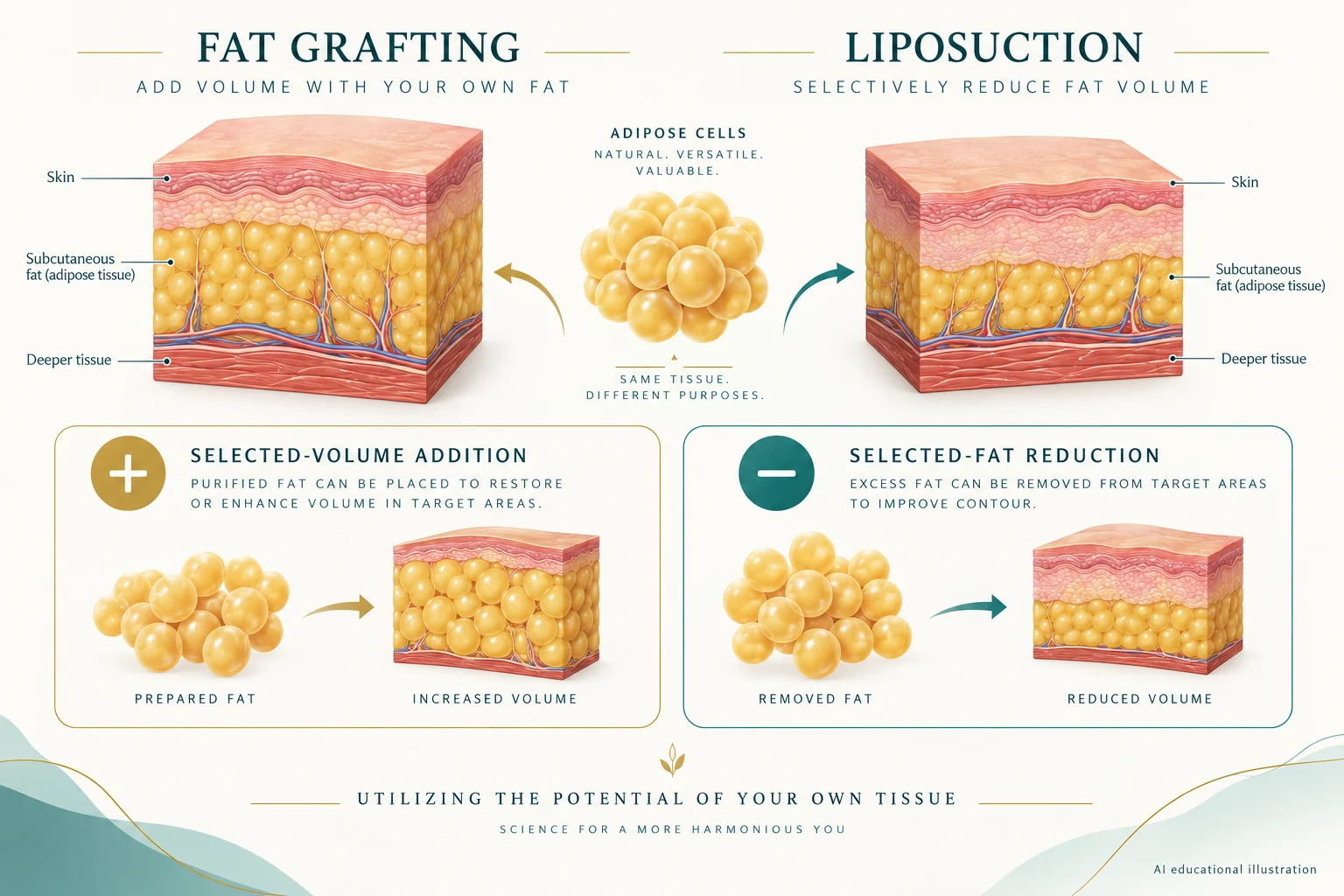
Ask about donor-site care, contour irregularity, lumps or asymmetry, and the risks of injection into facial tissues. A severe unexpected symptom or visual change after an injection requires urgent assessment. The illustration compares volume addition and reduction without suggesting that all facial areas are equally suitable.
Send a short inquiry before buying non-changeable tickets
State your main concern, preferred language, previous facial treatment and tentative dates. Ask whether an in-person examination, tests or additional information will be needed before a recommendation can be made. Do not interpret an available appointment as confirmation that surgery is appropriate or that it will take place on the same day.
Ask who will explain medical consent in a language you understand and how you will communicate during follow-up. Keep medical decisions with the treating team. You can explore more preparation topics in the KOMD journal, then use DI’s consultation information for clinic-specific arrangements.
Build a calendar around reviews, not only the treatment day
Request a written outline covering assessment, treatment if recommended, early review of the face and donor site, any dressing or stitch appointments, and a review before departure when required. Ask which appointments are essential, which can change and what would make the surgeon recommend a longer stay.
DI publishes general initial-recovery and follow-up information, but those figures do not establish the number of nights you need. An appointment for a body harvest incision may remain necessary even when the face has no stitches to remove. Ask the clinic to confirm the actual plan for you before committing to onward travel.
A useful booking approach is to keep the departure and accommodation changeable until the assessment and review schedule are clear. Do not schedule a second city or strenuous excursion between medical appointments on the assumption that you will feel well enough.
What the proposed procedure should specify
Specify single-area versus full-face treatment and whether a second session, PRP or harvesting line item is included.
Before consent, ask the clinician to name the operation and alternatives, explain the main objective and limitations, and confirm the person responsible for treatment and postoperative review. A schematic, a price item or a case video cannot establish suitability for an individual patient.
Verified DI price guide: KRW, VAT included
Source: DI 2026 English Price Guide, dated 11 September 2026, page 4; checked on 7 October 2026. The guide labels these as general prices in Korean won with VAT included.
The separately named procedure/package options below span KRW 600,000–2,300,000, VAT included. This range compares different scopes; it is not a promised total for one operation.
These rows are different procedures, packages or add-ons. An add-on is not the full operation price. The guide’s price does not establish which anesthesia, materials, tests, medicines, aftercare or additional procedures are included in your case. Request an itemized current quote before booking.
| Verified item | KRW, VAT included | Price scope |
|---|---|---|
| Facial fat grafting, one area | KRW 600,000 | Listed procedure fee |
| Full-face fat grafting, first treatment | KRW 1,200,000 | Listed procedure fee |
| Full-face fat grafting, second treatment | KRW 1,400,000 | Listed procedure fee |
| Two initial treatments + PRP package | KRW 2,300,000 | Listed procedure fee |
| PRP | KRW 100,000 | Add-on only; not a standalone procedure price |
| Harvesting line item | KRW 400,000 | Add-on only; not a standalone procedure price |
Choose accommodation for practical care needs
After the clinic confirms its address and appointment locations, compare the actual door-to-door journey rather than only the district name. Check elevator access, a place to rest, a bathroom you can use comfortably and whether the booking can be extended. None of these features makes a hotel a medical facility.
Ask whether the planned anesthesia requires an accompanying adult and what support is needed after discharge. A driver is not automatically a caregiver, and an interpreter is not automatically able to provide clinical aftercare. Confirm these roles separately instead of relying on a general travel-service description.
Plan clothing, luggage and transport around the donor site
Tell the treating team where you expect to stay and how you plan to travel. Ask whether your proposed clothing, bag straps, sitting position or luggage handling could put pressure on a treated area. Take the instructions for your actual donor site; advice for somebody else’s thigh or abdomen may not apply.
Arrange help with heavy luggage when needed and keep an uncomplicated route back to the clinic. Airport transfer, walking tours and shopping should be considered separately from discharge. Do not assume that being able to sit in a car means you have been cleared for a long flight.
Keep face care and harvest-site care on separate checklists
Ask for written directions for washing, dressings, medicines, pressure on the face, activity and any donor-site garment. Confirm whether a garment is needed at all before buying one. Do not add massage, compresses, dietary restrictions or extra treatments from social media in an attempt to improve the result.
Also obtain the clinic’s contact route, out-of-hours instructions and a plan for urgent medical assessment. Infection, bleeding, lumps, unevenness, fat necrosis and anesthesia-related problems are among the issues to discuss. ASPS identifies rare blindness as a possible complication of facial fat transfer. Suitability, effects, price and recovery require individual evaluation; this is not a complete risk list or a personal medical assessment.
If an urgent problem develops, seek appropriate local care rather than waiting for a travel coordinator or an online message. Before leaving Korea, ask what records to take, who will review later concerns and how any examination at home will be coordinated.
Do not plan a second session as an automatic part of the trip
The amount of retained volume may change over time, so ask when reassessment would be meaningful. A return visit for additional treatment, if considered, is a new planning decision rather than a guaranteed step. Clarify who evaluates it, whether another examination is required and what charges or travel costs would apply.
Separate the medical quotation from accommodation, transport, language support and extension costs. Ask what is included in follow-up and how an unexpected change in the plan would be handled. A package total should not obscure the possibility of postponing or declining surgery.
An original one-month case is not a stay recommendation
The comparison below is DI’s designated gallery case 031, displayed as Fat grafting · Front · 1 month after surgery. Calendar capture dates, the pretreatment interval, donor site and injected volume are not displayed. No such details have been inferred.
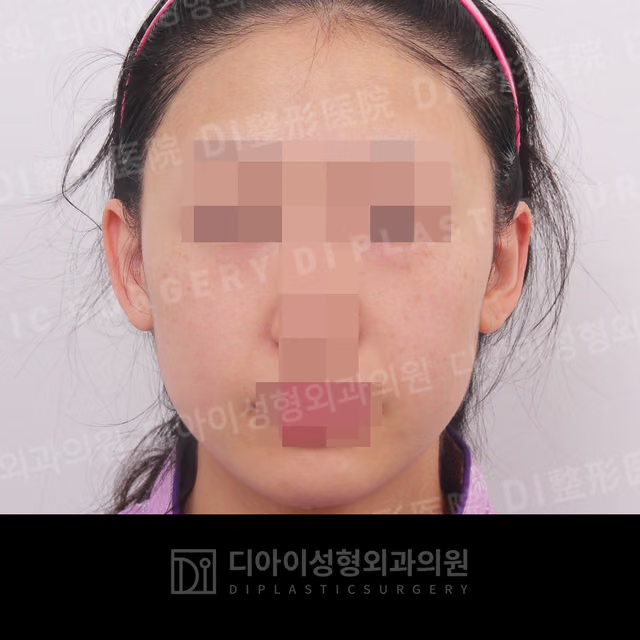
Before
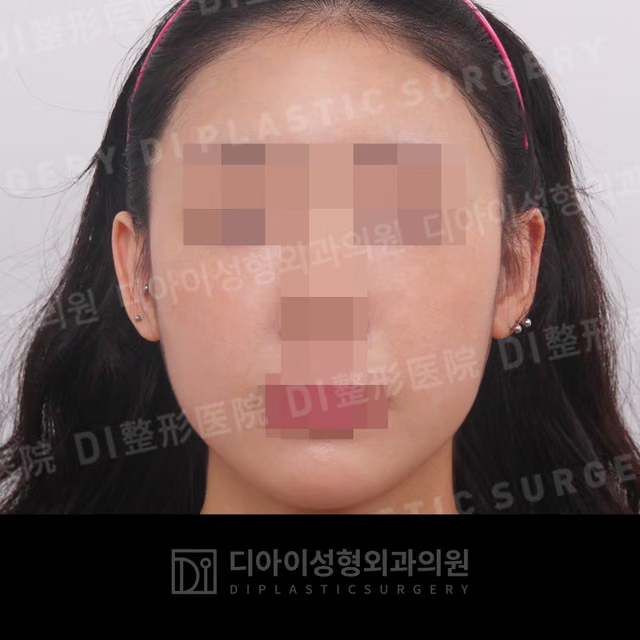
After · 1 month after surgery
Your pre-booking decision checklist
- Have the procedure and donor site been assessed rather than assumed?
- Do you know the required reviews and what could delay departure?
- Are language support, accompaniment and transport roles clear?
- Can you change your hotel and flight if the clinician advises it?
- Do you have written care instructions and contact routes for both treated areas?
If one of these is unanswered, resolve it before treating a proposed date as a complete travel plan. Choosing not to proceed remains an option. Travel organization can support care, but it cannot guarantee suitability, safety or an outcome.
Sources
- DI: published fat grafting and care information
- DI: original gallery case 031
- American Society of Plastic Surgeons: cheek augmentation and fat-transfer risks
- Australian Society of Plastic Surgeons: general fat-injection information
General educational travel planning, not personal medical advice. The three explanatory images are AI-generated; only the explicitly labelled original comparison is a patient case.
Preparation, aftercare and travel milestones
Before treatment, identify the exact donor and recipient areas for grafting or the exact fat-reduction area for liposuction. Tell the clinician about previous fillers, threads and surgery. Ask how skin laxity or deeper structures affect the proposed approach.
Get separate care instructions for donor and treated areas, access points, compression if prescribed and activity. Do not massage or put pressure on an operated area unless instructed. Ask how lumps, unevenness or persistent swelling will be assessed.
Confirm the number of intended treatments, what is included in each session and when results will be reviewed. A treatment-count package does not guarantee a retained fat volume. Plan travel around the clinic’s reviews and your individual recovery.

Risks and symptoms to discuss before consent
Discuss infection, bleeding, asymmetry, contour irregularity, sensation changes and possible further treatment. Fat grafting also needs a discussion of donor-site and injection-related risks, including rare serious vascular complications. A sudden visual change or severe unexpected symptom needs urgent assessment.
Ask which risks are most relevant to your examination, how complications would be handled, and what alternatives include postponing or not having treatment. Obtain written instructions from the treating team; a general article cannot replace them.
Questions before surgery and travel
Is the second session automatically included in the first-treatment fee?
No. The guide lists sessions and a package separately. Confirm the number of treatments and inclusions in writing.
Who confirms my final treatment plan and quotation?
The treating medical institution confirms suitability, the procedure, consent and the current itemized medical quotation. KOMD helps coordinate information and travel arrangements.
Does an early recovery estimate mean that I can fly?
No. Required reviews, wound or suture care and individual travel clearance must be confirmed by the treating clinician.
Procedure explanations and educational illustrations updated 7 October 2026. DI procedure information. Illustrations are AI-generated concepts, not actual patients or results. Medical decisions and current fees require clinic confirmation.