
For someone planning a facelift consultation in Seoul, the key travel question is not “How quickly can I fly home?” but “Which in-person reviews must my stay accommodate?” Build the trip around an individual clinical plan, then make accommodation and transport fit it. There is no universally safe number of nights to book from a website description.
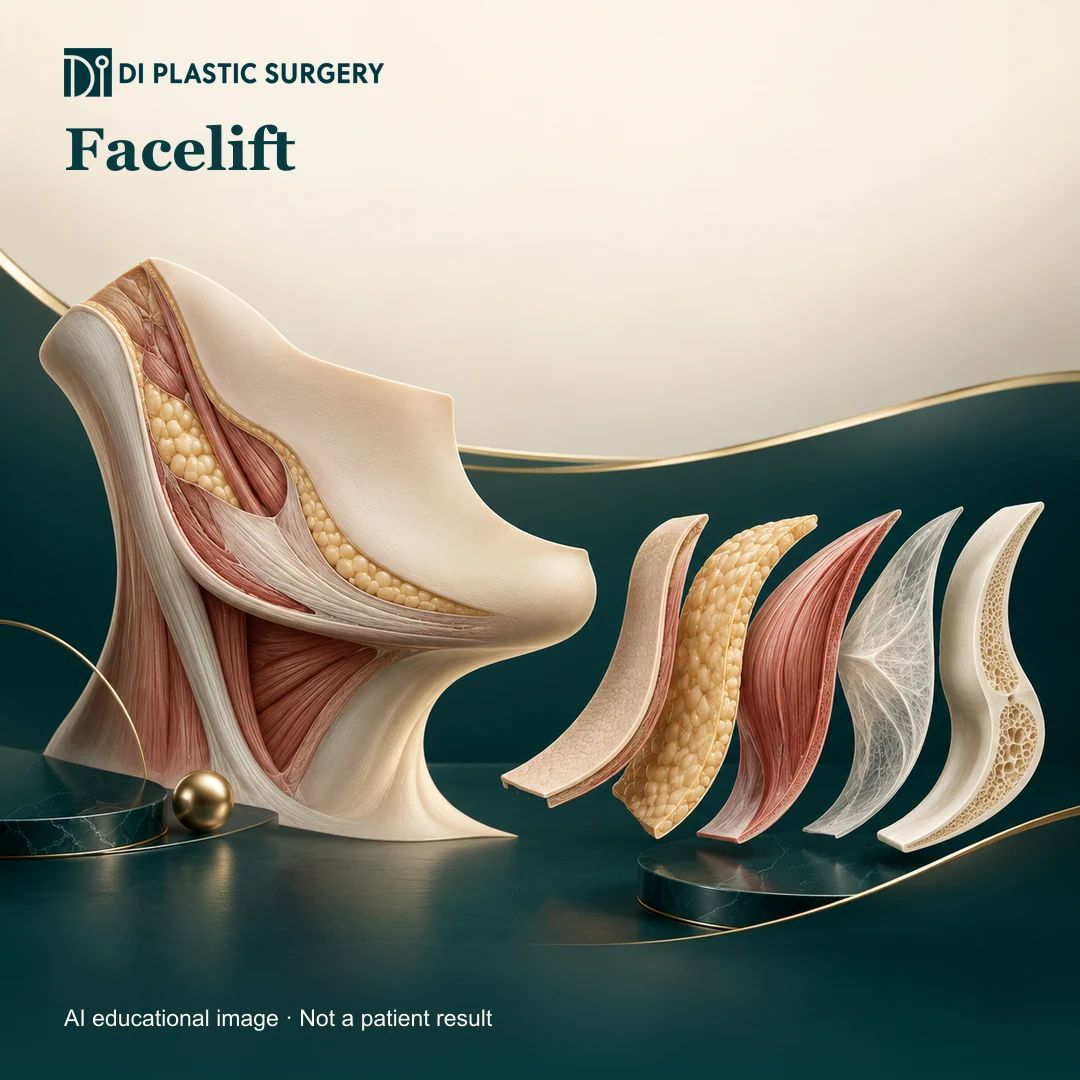
The cover and planning illustrations are AI-generated; they do not show an actual patient, a clinical result or a specific hotel.
Get the review requirements before choosing a departure date
Ask the clinic for a provisional outline of the consultation, any assessment before surgery, planned postoperative checks and what would trigger an additional visit. Ask whether dressings, drains or sutures would need clinical attention and who would handle that care. These are questions for the treating team, not instructions to manage them yourself.
DI’s official facelift overview states that sutures require removal and follow-up is needed, while recovery varies. That does not translate into a fixed travel package. Clarify which dates are tentative and which clinical decisions must be made after examination or during recovery. Use the KOMD procedure directory to organize your research without treating a listing as confirmation of eligibility.
Understanding facelift
A facelift assesses facial soft-tissue descent, skin excess and the supporting layers beneath the skin. It differs from adding volume to a hollow area or treating skin texture. A lower-face concern can also involve the neck, which needs its own assessment.
The plan should describe the area treated, incision route and how the supporting tissues are addressed. A mini lift and a full facelift can have different extent and fees; a short incision does not by itself explain the full technique.
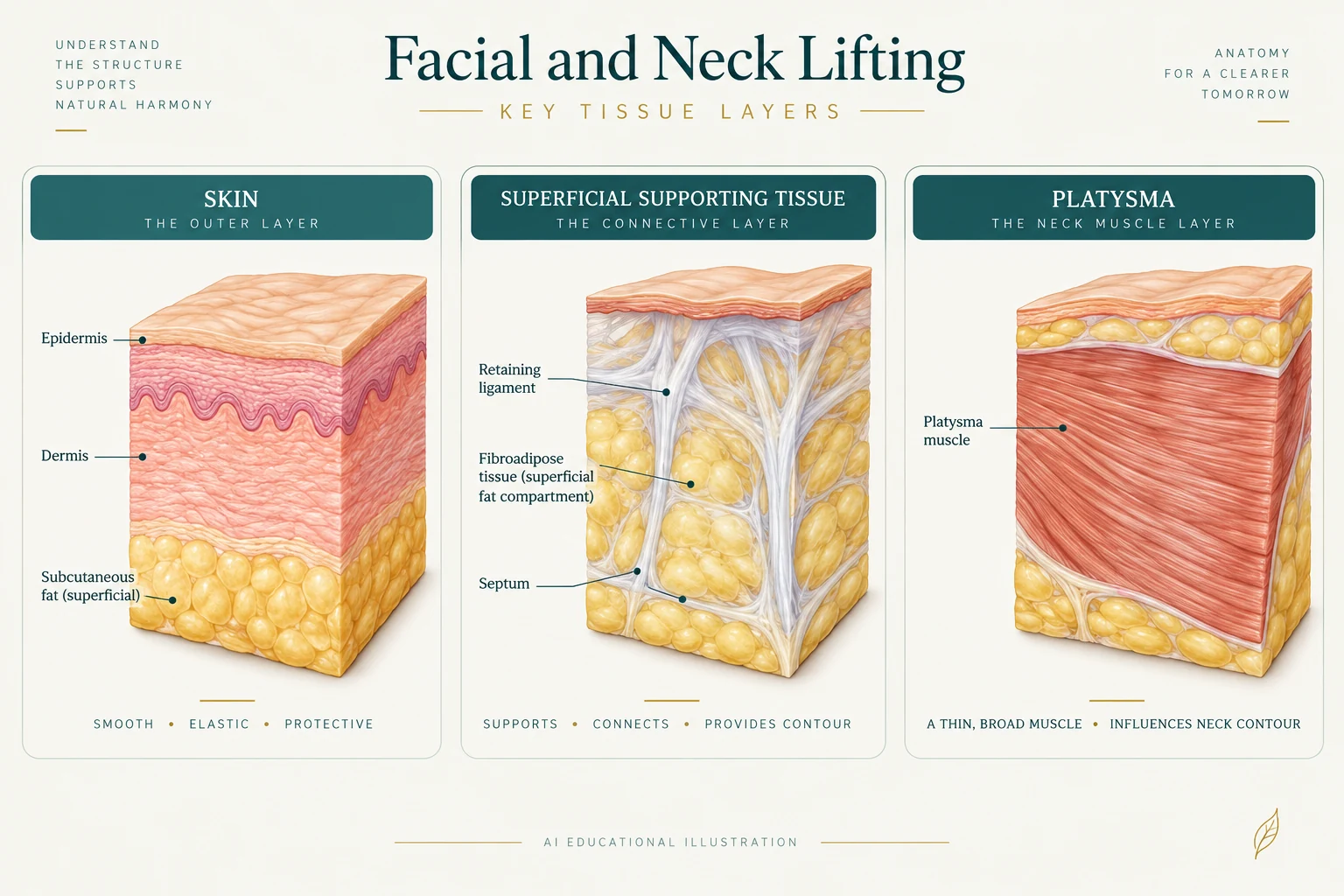
Ask where incisions will be placed near the ear or hairline, whether neck treatment is included and what changes are outside the procedure’s scope. The layered illustration shows skin, support and deeper structures as separate concepts, without representing a specific dissection plane or result.
Separate the surgical plan from the travel plan
Before paying for non-refundable bookings, confirm what the proposed operation actually includes. A facelift label alone does not confirm a neck lift, a particular tissue technique, anesthesia choice or personal outcome. The clinician should explain suitability, alternatives, limitations, risks and an itemized price. Read the DI medical-team information and bring previous-procedure and health-history questions to an individual consultation.
Your travel checklist should record the clinic’s review requirements, not replace them with an itinerary copied from another patient. Keep a separate column for arrangements you can change: accommodation extension, transport and your return booking. Confirm change fees and availability directly with the providers; do not assume “flexible” means refundable.
Choose accommodation for repeated access, not just sightseeing
Evaluate the actual route between a shortlisted property and the clinic, including the entrance, lift access and street crossings—not simply the distance on a map. Ask the property about extension availability, a quiet room, suitable bathroom facilities and meal options that match your clinical instructions. None of these features makes a hotel a medical-care provider.
Ask the clinical team what help you may need after discharge and whether a companion is appropriate. If traveling with someone, agree who will assist with appointments, luggage and communication. A reception desk or travel coordinator should not be assumed to provide postoperative monitoring.
What the proposed procedure should specify
Compare the scope of MACS, short-scar mini and full-face options; ask about scar care, hematoma, nerve-related risks and follow-up.
Before consent, ask the clinician to name the operation and alternatives, explain the main objective and limitations, and confirm the person responsible for treatment and postoperative review. A schematic, a price item or a case video cannot establish suitability for an individual patient.
Verified DI price guide: KRW, VAT included
Source: DI 2026 English Price Guide, dated 11 September 2026, page 5; checked on 7 October 2026. The guide labels these as general prices in Korean won with VAT included.
The separately named procedure/package options below span KRW 3,000,000–6,000,000, VAT included. This range compares different scopes; it is not a promised total for one operation.
These rows are different procedures, packages or add-ons. An add-on is not the full operation price. The guide’s price does not establish which anesthesia, materials, tests, medicines, aftercare or additional procedures are included in your case. Request an itemized current quote before booking.
| Verified item | KRW, VAT included | Price scope |
|---|---|---|
| MACS mini facelift | KRW 3,000,000 | Listed procedure fee |
| Short-scar mini lower-face lift | KRW 4,000,000 | Listed procedure fee |
| Full facelift | KRW 6,000,000 | Listed procedure fee |
Arrange local journeys that can be adjusted
Keep the clinic address in Korean and English, the appointment time and a working clinic contact route accessible on your phone. Confirm transport arrangements and accessibility with the provider. Ask the clinical team about appropriate travel arrangements after your procedure; do not assume you will be able to drive, carry luggage or use a crowded commute immediately afterward.
Plan one practical return journey at a time. Avoid making long sightseeing excursions, strenuous activities or another city visit the default between reviews. Whether an activity is appropriate depends on the instructions and assessment you receive, not how energetic another patient appeared in a photograph.
Make communication part of the itinerary
Confirm the language available for consultation and written aftercare before arrival. Ask for instructions covering wound care, medications, washing, activity, follow-up and symptoms that need attention. Check that you understand the clinic’s urgent contact arrangements and how to seek emergency care; an online travel inquiry is not an emergency service.
Facelift surgery can involve bleeding, infection, anesthesia complications, nerve injury, altered sensation, poor healing or scarring, among other risks. Ask the surgeon about your personal risk and what would happen if recovery requires extra review. Do not stop or change prescribed medication based on travel content.

An original case is not a departure timetable
The designated DI gallery displays case 195 as Facelift, in a 45° view, with the after-image labeled 2 months after surgery. That relative interval describes the displayed photograph; it does not establish when this person traveled or how long you should stay. Calendar capture dates are not supplied here and have not been inferred.


Full original photographs retain their existing privacy masking and original branding. No AI retouching, added overlays or result-altering crops have been applied. Individual results and recovery vary; this single case does not predict your outcome. View the original DI gallery and look for case 195. The three generated illustrations are not clinical evidence.
Keep departure conditional on your own assessment
Before returning home, ask the clinician whether your planned journey is appropriate, what care is still needed and how to arrange follow-up or assessment after departure. Record whom to contact and how any documents will be shared securely. A completed appointment list does not by itself establish fitness to fly.
Begin with your proposed dates, consultation language and general planning questions through the DI consultation page. Avoid sending sensitive medical records through a general inquiry unless the clinic supplies an appropriate channel. Suitability, effects, cost and recovery require individual evaluation. Find related travel-planning articles in the KOMD Journal.
Sources
- DI: official facelift overview and individual-assessment notice
- DI: original gallery, Facelift case 195, 45°, 2 months after surgery
- ASPS: individualized recovery and follow-up questions
- ASPS: facelift risks and safety
This educational travel-planning article does not replace a clinical examination or individualized medical advice.
Preparation, aftercare and travel milestones
Before treatment, review previous lifting, threads, fillers or surgery, medicines, allergies and smoking or nicotine use. Ask who performs the procedure, how anesthesia is assessed and what monitoring is planned. Confirm each combined procedure separately.
Get written instructions on dressings, drains if used, wound care, hair washing, compression if prescribed and activity. Ask about expected swelling and when a rapidly increasing swelling, severe pain or other unexpected change needs immediate review. Suture removal and return to normal activity are separate milestones.
Build your stay around wound reviews and the surgeon’s assessment of recovery. Confirm how to contact the clinic after hours and after returning home. A limited-incision operation or a short procedure does not establish a fixed safe flight date.

Risks and symptoms to discuss before consent
Discuss bleeding or hematoma, infection, scarring, asymmetry, sensation changes, nerve-related complications and possible revision. Thread procedures also require discussion of visible or palpable threads, dimpling and removal. Risks vary with the operation actually proposed.
Ask which risks are most relevant to your examination, how complications would be handled, and what alternatives include postponing or not having treatment. Obtain written instructions from the treating team; a general article cannot replace them.
Questions before surgery and travel
Does the lowest mini-lift price apply to a full facelift?
No. KRW 3,000,000–6,000,000 covers different named options. A quote must identify the actual extent of treatment.
Who confirms my final treatment plan and quotation?
The treating medical institution confirms suitability, the procedure, consent and the current itemized medical quotation. KOMD helps coordinate information and travel arrangements.
Does an early recovery estimate mean that I can fly?
No. Required reviews, wound or suture care and individual travel clearance must be confirmed by the treating clinician.
Procedure explanations and educational illustrations updated 7 October 2026. DI procedure information. Illustrations are AI-generated concepts, not actual patients or results. Medical decisions and current fees require clinic confirmation.