
KOREA MEDICAL TRAVEL · VISA PLANNING
Korea Medical Visa Guide
C-3-3, G-1-10 & what a registered facilitator can help with
Can a medical-tourism agency issue a Korean visa? No. Visas are issued by Korean authorities. A registered international-patient facilitator may support a medical invitation and, where eligible, an application. Medical e-Visa proxy access requires a separate designation.
Source: Korea Visa Portal — application procedures · Korea Immigration Service — online visa center
01 / CHOOSE THE RIGHT CATEGORY
C-3-3 and G-1-10 at a glance
| Category | Typical purpose | Stay framework |
|---|---|---|
| C-3-3 Medical tourism |
Short treatment or recuperation, including eligible cosmetic procedures and plastic surgery. | Up to 90 days. |
| G-1-10 Treatment & recuperation |
Longer medical treatment or rehabilitation. | Long-term route; public guidance describes up to one year, subject to the individual grant. |
These are category descriptions, not a decision on your eligibility. Confirm the category and approved stay with the responsible Korean mission. Allow time for the treatment, clinical follow-up and travel clearance when discussing your plan with the provider.
02 / UNDERSTAND THE ROLES
Who issues which document?
Medical provider
Medical assessment, diagnosis, treatment plan and appointment confirmation.
Registered facilitator
Invitation support, clinic communication, language assistance and visit coordination within its verified role.
Korean authorities
Visa assessment, issuance-confirmation decisions and visa issuance through the applicable official route.
A facilitator can prepare its own factual invitation or coordination letter. It cannot create a doctor’s diagnosis, replace a clinic’s medical decision or issue a government visa-issuance confirmation.
Source: KLRI — Act on Supporting Overseas Expansion of Medical Services and Attraction of International Patients · VISITKOREA — Medical Visa Issuance · Korea Visa Portal — application procedures
KOMD’s documented role
KOMD provides international-patient information and coordination. Its existing registration certificate shows No. A-2026-10-02-07015, with a printed validity of 17 June 2026–16 June 2029. View the original registration certificate.
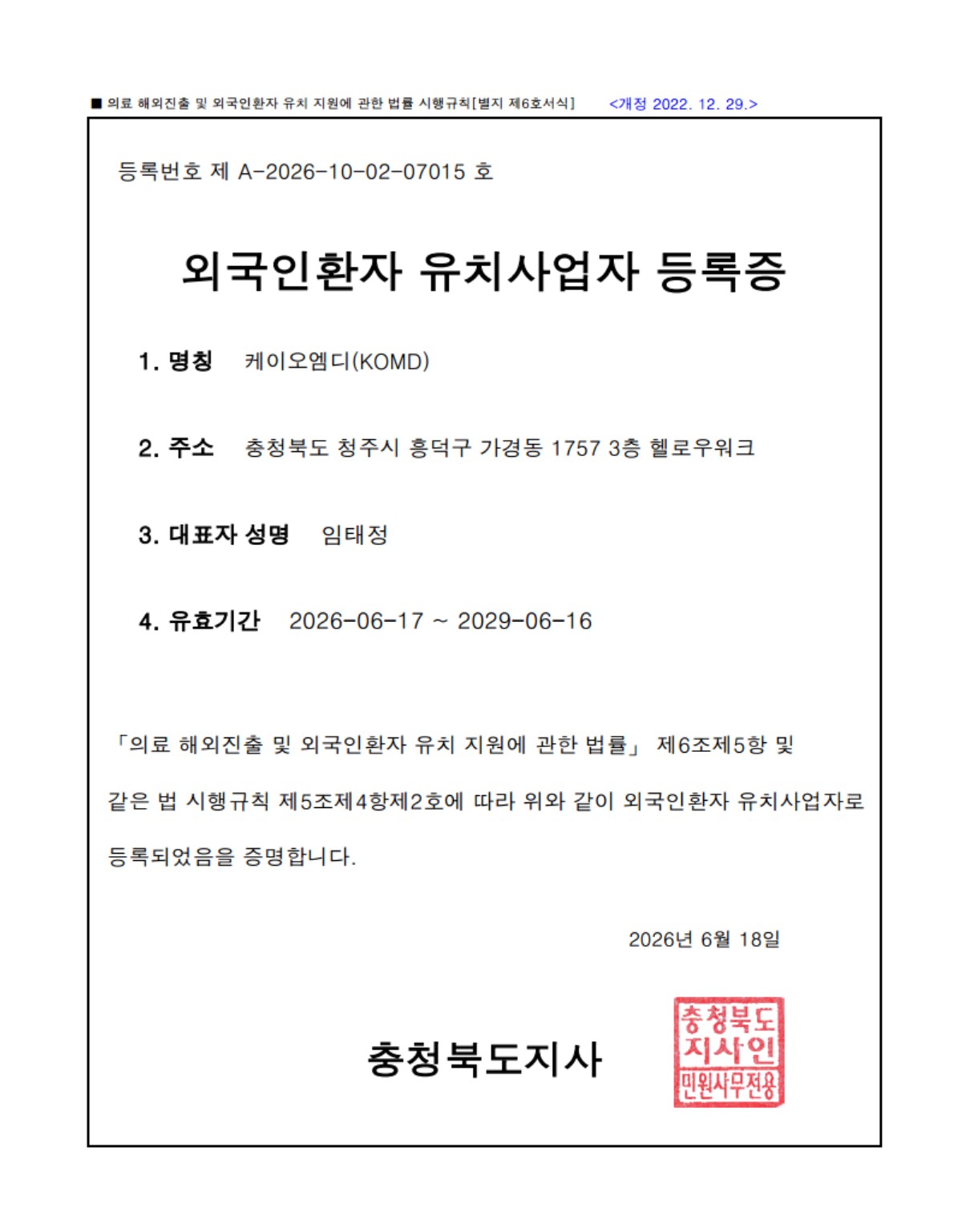
Registration and Ministry of Justice “excellent medical-tourism institution” designation are different. This guide does not represent KOMD as a designated medical e-Visa proxy. Any invitation or application-support scope must be confirmed for the specific case before documents are requested.
03 / KNOW THE APPLICATION ROUTE
Three routes that should not be confused
1. Apply through a Korean embassy or consulate
The patient follows the mission responsible for their residence, using its current checklist and submission arrangements. Requirements can differ by nationality and jurisdiction.
2. Inviter applies for confirmation of visa issuance
For eligible medical invitations, the inviter submits the application in Korea. Immigration reviews it. If approved, the applicant uses the confirmation number or document to apply for the visa at the Korean mission.
3. Medical e-Visa through a designated institution
The Visa Portal limits the medical e-Visa proxy route to eligible excellent international-patient institutions designated for that purpose. Ordinary facilitator registration alone is insufficient.
Source: Korea Visa Portal — application procedures · Korea Immigration Service — online visa center
The Ministry of Justice’s September 2026 notice lists 112 designated institutions for 1 October 2026–30 September 2027. Designation can be withdrawn during that period; check the inviting institution’s current status rather than relying on a logo or a past certificate.
Source: MOJ Notice 2026-413 — excellent medical-tourism institutions
Do not book an itinerary around a generic “fast visa” claim. Ask which route will actually be used, who submits it, which office decides and which documents remain necessary.
04 / BUILD A CONSISTENT FILE
Medical visa preparation checklist
Start with the responsible mission’s checklist. Medical Korea’s general guidance includes identity, medical-purpose and funding evidence. Additional documents may be requested.
Patient & identity
- Application, passport and required photograph.
- Residence or local-status evidence where the mission requires it.
- Matching name, dates and visit purpose across the file.
Medical & visit plan
- Diagnosis or medical note when required.
- Confirmed Korean medical appointment and treatment/recuperation plan.
- Clinic and inviter registration documents required for the route.
Funding & companion
- Evidence of funds for treatment and the stay.
- Caregiver relationship evidence and patient documentation, if applicable.
- Required translations, original/copy format and document issue dates.
Source: Medical Korea / KHIDI — Medical Visa · Embassy of Korea in Singapore — C-3-3 Medical Tourism Visa
For a first inquiry, share your nationality, country of residence, approximate visit dates and preferred clinic service. Do not send passport scans, bank statements or detailed medical records in a public comment. Agree on the necessary documents, recipient and a suitable private delivery method first.
05 / PUT THE STEPS IN ORDER
A practical sequence before you travel
- Check your entry routePassport nationality, residence, purpose and intended length of stay.
- Confirm the clinic planProvider, appointment, estimated care period and follow-up needs.
- Confirm the inviter’s roleRegistration, route eligibility and who prepares each document.
- Submit & await the decisionFollow official instructions; keep copies and consistent dates.
- Check the issued conditionsEntry validity, permitted stay and instructions before booking final travel.
Ask for a written breakdown of treatment, accommodation, translation, application assistance and official charges. Confirm who receives each payment and the cancellation terms. This guide does not quote a universal visa fee or processing deadline.
06 / CHECK YOUR OWN ENTRY STATUS
Visa-free travel, K-ETA and visitors already in Korea
K-ETA is travel authorization for eligible visa-exempt visitors; it is not a C-3-3 medical visa and does not extend the permitted visa-free stay. An approved authorization does not guarantee entry.
Source: VISITKOREA — Visa and Travel Requirements
The official temporary K-ETA exemption currently runs through 31 December 2026 (KST) for the countries/regions already covered by that exemption. It is not a waiver for every passport. Recheck the official notice for your travel date.
Source: K-ETA — extension of temporary exemption
If you already hold a Korean visa or are already in Korea, ask immigration whether the proposed care fits your current conditions and whether another procedure is needed. Do not assume that a clinic booking or invitation extends your stay. Contact 1345 in Korea or +82-2-1345 from overseas for immigration guidance.
Source: Korea Immigration Service — Immigration Contact Center 1345
07 / QUICK ANSWERS
Korea medical visa FAQ
Can a Korean medical-tourism agency issue my visa?
No. A registered facilitator can support an invitation and coordination; Korean authorities decide and issue the visa. An agency letter is not government approval.
Which medical visa covers a short skin-treatment or plastic-surgery trip?
C-3-3 is the medical-tourism category for a stay of up to 90 days. The consulate must confirm whether it fits your nationality, treatment plan and circumstances.
Does registration mean KOMD can submit a medical e-Visa?
No. Medical e-Visa proxy applications require separate Ministry of Justice designation and the relevant portal eligibility. This page does not claim that KOMD holds that designation.
Can a caregiver travel with the patient?
A caregiver may be considered under the relevant medical-visa route. Prepare relationship evidence and the patient’s documents; eligibility and the required evidence must be confirmed for that application.
Is an invitation letter or a visa-issuance confirmation enough to travel?
An invitation is supporting evidence. A confirmation of visa issuance is a government pre-approval used for a subsequent consular visa application. Follow the approved route and check the issued visa and entry requirements before travel.
Source: Korea Visa Portal — application procedures · Medical Korea / KHIDI — Medical Visa · Korea Immigration Service — online visa center · Embassy of Korea in Singapore — C-3-3 Medical Tourism Visa
PLAN YOUR CLINIC VISIT
Start with a clear appointment inquiry
KOMD can organize your clinic inquiry and visit-planning questions. The medical provider confirms care; the relevant Korean authority confirms immigration requirements.
Official sources & editorial notes
This information page was prepared by KOMD from the sources below. It is general visit-planning information, not an immigration decision or individualized legal advice. Verify current instructions with the responsible authority before applying. No visa approval, entry, stay length, processing time or medical outcome is guaranteed.
- Korea Visa Portal — application procedures
- Medical Korea / KHIDI — Medical Visa
- Korea Immigration Service — online visa center
- MOJ Notice 2026-413 — excellent medical-tourism institutions
- VISITKOREA — Medical Visa Issuance
- Embassy of Korea in Singapore — C-3-3 Medical Tourism Visa
- KLRI — Act on Supporting Overseas Expansion of Medical Services and Attraction of International Patients
- K-ETA — extension of temporary exemption
- VISITKOREA — Visa and Travel Requirements
- Korea Immigration Service — Immigration Contact Center 1345
- KOMD original foreign-patient facilitator registration certificate