
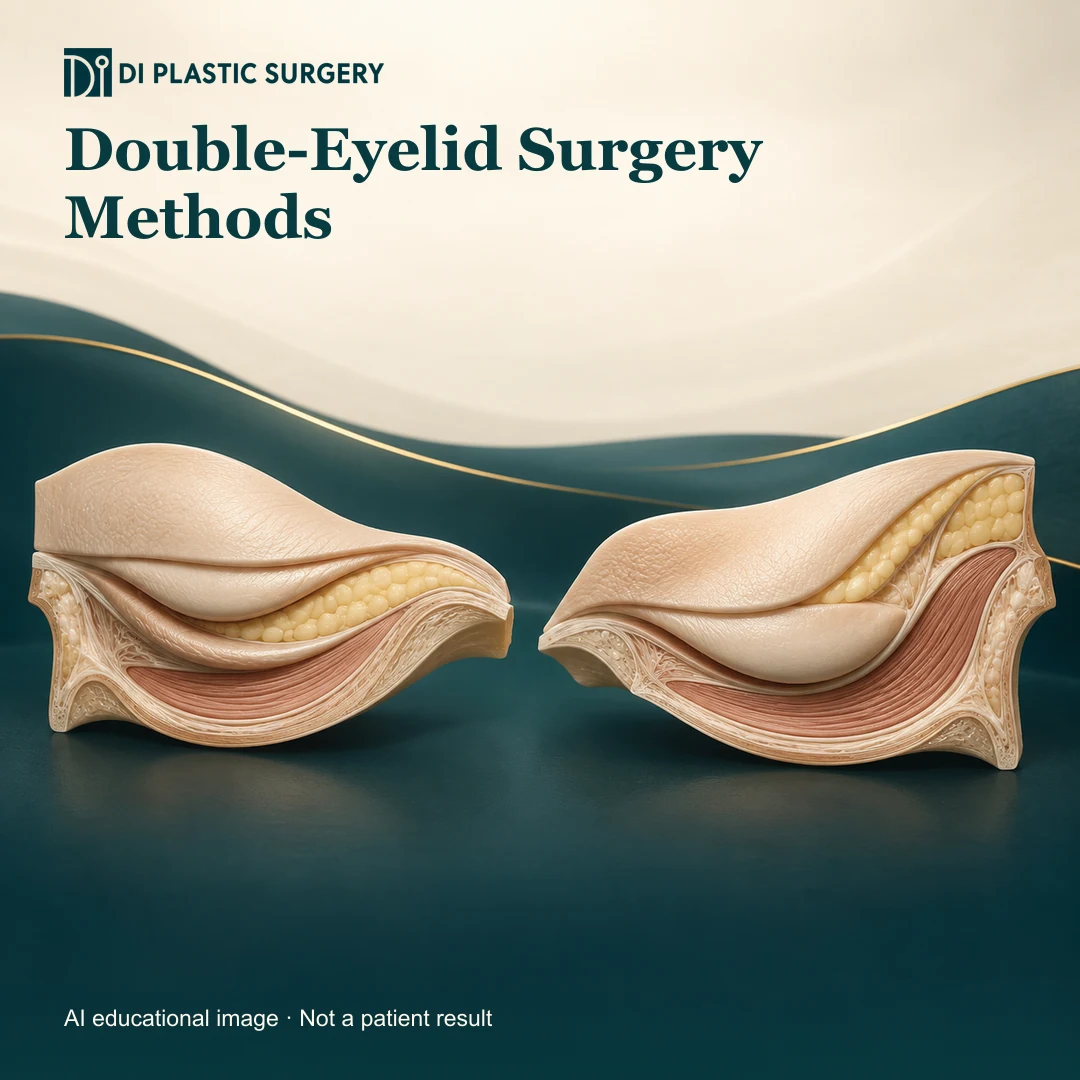
Comparing double-eyelid options before a Seoul trip is easier when you separate two questions: what crease you would like to discuss, and which technique a surgeon considers appropriate for your eyelids. An online photograph cannot settle either question. Use this guide to prepare a consultation, rather than to select a procedure or book a fixed recovery itinerary.
Start with your consultation goal, not a method label
For an international visitor, a useful goal is to understand the proposed crease, the reasons for the recommended method, and the follow-up arrangements before making a decision. Write down what concerns you about your current eyelids and what you hope to discuss. Bring reference images as conversation aids, not as promises of a reproducible result.
DI’s double-eyelid surgery overview describes crease design separately from surgical approaches. Terms such as tapered, in-out, parallel and semi-parallel describe how a fold relates to the inner corner and the rest of the eyelid. They are not interchangeable with names such as natural adhesion or incisional surgery. Ask the surgeon to explain both aspects in language you understand.
Understanding double-eyelid surgery
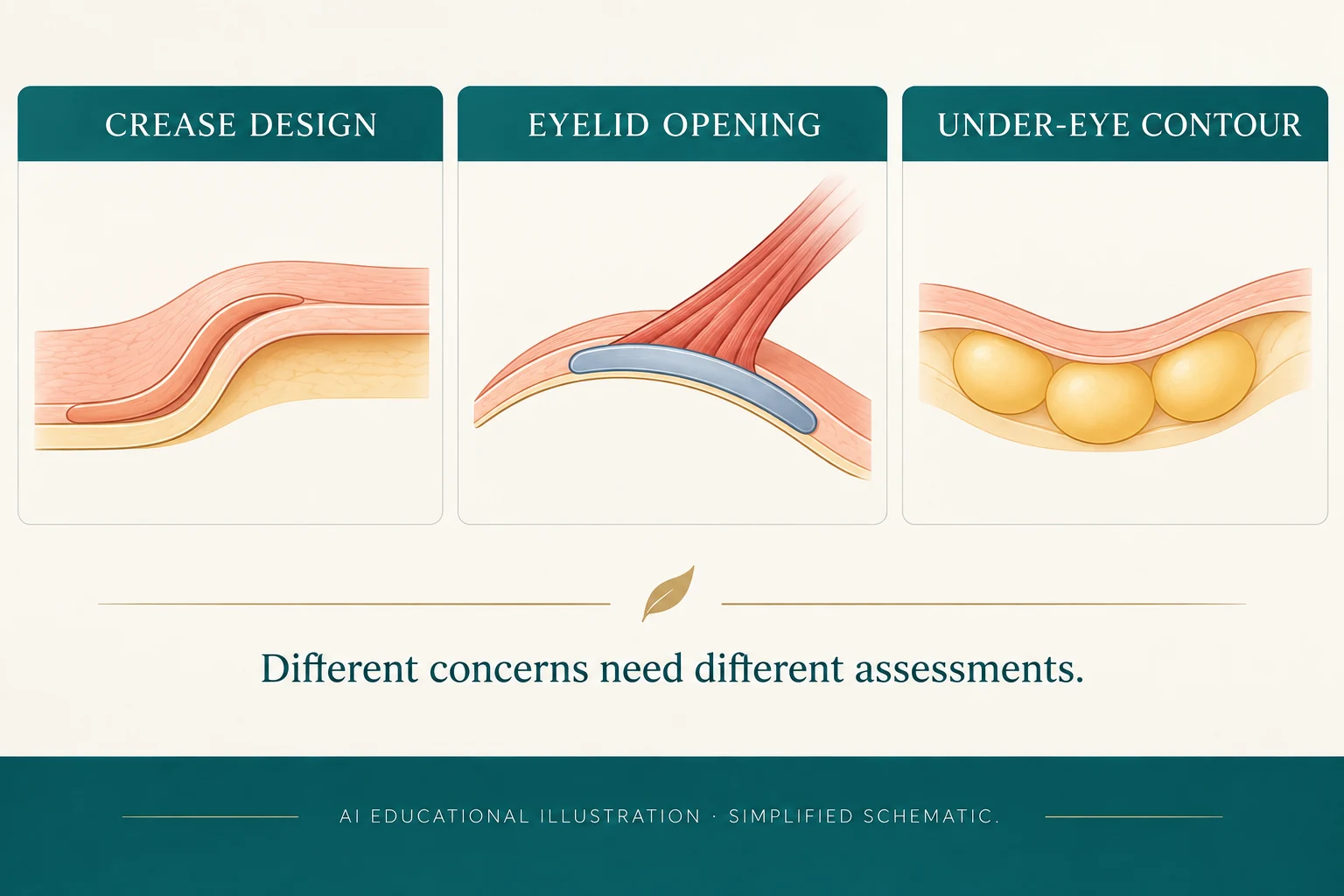
Double-eyelid surgery creates or adjusts the upper-eyelid crease. The crease is a fold formed by the relationship between the eyelid skin and deeper supporting tissues; it is separate from the height at which the eyelid margin rests. The surgeon assesses skin thickness, existing folds, fat, brow position and the way each eye opens before discussing crease design.
Buried-suture methods use small entry points to establish attachments. Incisional methods use a crease-line incision and may allow direct adjustment of selected tissues. Neither approach automatically corrects every cause of a heavy upper eyelid. The illustrated skin fold explains the idea of crease formation; it is a simplified drawing rather than a surgical instruction.
Tapered, parallel or other crease preferences must be discussed against the available skin and individual anatomy. A high crease in a reference photograph may be unsuitable for another eyelid. Existing asymmetry should be recorded before surgery so that a realistic goal can be agreed.
Prepare a short comparison worksheet
Leave room for the surgeon’s answers instead of filling the worksheet with assumptions. For each proposed approach, record the reason it is being considered, the limitations, the expected incision or fixation approach, and the plan if the result or healing differs from expectations.
- Which findings from my examination support this recommendation?
- How does the proposed crease relate to my existing anatomy and asymmetry?
- Is a separate eyelid-function assessment relevant, or is this a crease-design discussion only?
- What are the risks, alternatives and reasons not to proceed?
- Which reviews need to happen in Seoul, and how will later concerns be assessed?
To understand the vocabulary before your appointment, see our separate guides to planning a natural-adhesion consultation, planning an incisional eyelid consultation and a Seoul visit for ptosis assessment. These are preparation guides, not a way to diagnose yourself or rank one technique as universally better.

Share health information before you commit to travel
The American Society of Plastic Surgeons identifies goals, eye problems, medical conditions, medications and previous surgery as important consultation topics. Prepare an accurate list, including supplements and allergies, and tell the clinic about previous eyelid procedures. Ask what records are useful and how they should be shared securely. Do not change prescribed medication because of a travel article.
Confirm whether language assistance is available for the consultation, consent discussion and postoperative instructions. A photograph-based inquiry may help organize an appointment, but it is not a final assessment of suitability, a confirmed treatment plan or a medical clearance.

What the proposed procedure should specify
Ask which method is proposed, why it suits your tissues, where scars or entry points will be, and whether ptosis or brow treatment is a separate decision.
Before consent, ask the clinician to name the operation and alternatives, explain the main objective and limitations, and confirm the person responsible for treatment and postoperative review. A schematic, a price item or a case video cannot establish suitability for an individual patient.
Verified DI price guide: KRW, VAT included
Source: DI 2026 English Price Guide, dated 11 September 2026, page 2; checked on 7 October 2026. The guide labels these as general prices in Korean won with VAT included.
The separately named procedure/package options below span KRW 600,000–1,400,000, VAT included. This range compares different scopes; it is not a promised total for one operation.
These rows are different procedures, packages or add-ons. An add-on is not the full operation price. The guide’s price does not establish which anesthesia, materials, tests, medicines, aftercare or additional procedures are included in your case. Request an itemized current quote before booking.
| Verified item | KRW, VAT included | Price scope |
|---|---|---|
| Buried-suture double-eyelid surgery | KRW 600,000 | Listed procedure fee |
| Natural-adhesion double-eyelid surgery | KRW 700,000 | Listed procedure fee |
| Incisional double-eyelid surgery | KRW 1,400,000 | Listed procedure fee |
Keep your Seoul itinerary conditional
Before buying non-refundable tickets, ask the clinic for the anticipated examination, treatment and review sequence. Clarify whether surgery could be deferred after assessment, which appointments require an in-person visit, and what support is available if your stay changes. There is no single flight-home day suitable for every technique or every patient.
If surgery is recommended, ask the treating team about accommodation needs, transport after treatment, contact-lens use, work commitments and return-to-flight advice. Obtain an itemized quotation that explains what is included and how additional care would be handled. Suitability, results, price and recovery all depend on individual assessment; a short holiday timetable should not decide the operation.
A verified gallery example: what it does and does not show
DI’s designated Before & After gallery identifies case 277 as incisional double-eyelid surgery, photographed 1 month after surgery. The original front-view pair is shown below without retouching, cropping or overlays. It is one documented example of that method, not a comparison with natural adhesion and not a prediction of another person’s outcome.
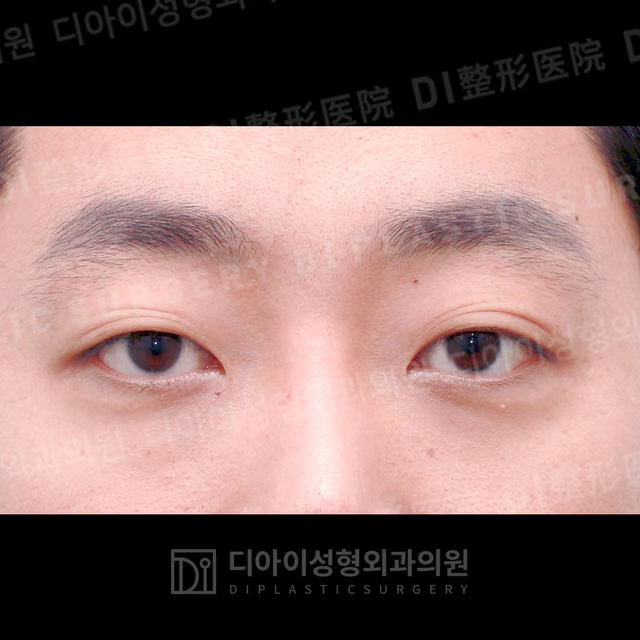
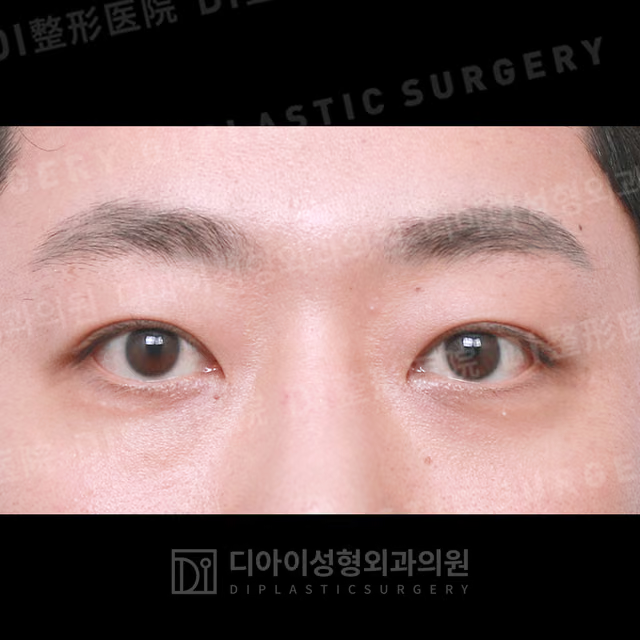
Results vary. This follow-up photograph is not a guarantee of a final result. Verify the case in the original DI gallery by searching “case-277”. These two original photographs are hosted by DI; the three editorial illustrations are hosted in KOMD’s media library.
Discuss risks and a written follow-up plan
Bleeding, infection, dry or irritated eyes, difficulty closing the eyes, asymmetry, scarring and the possibility of further treatment belong in the informed-consent discussion. Rare serious visual complications should also be discussed with the surgeon. The exact risks depend on the procedure and the patient. Ask whom to contact urgently, how to access local emergency care and what to do if symptoms develop after returning home.
Your next step can be a consultation without a commitment to surgery. Review DI’s medical-team information and consultation process, and explore the KOMD journal for related travel-planning guides. Travel coordination does not replace a treating clinician’s decision.
Sources and scope
- DI double-eyelid surgery overview — clinic-specific terminology and consultation context.
- DI Before & After gallery — original case 277 and displayed 1-month follow-up.
- ASPS: eyelid surgery consultation — information to discuss with a surgeon.
- ASPS: eyelid surgery safety — general risk discussion, not a patient-specific assessment.
Sources and displayed gallery details checked on 1 October 2026. This is general educational and travel-planning information, not medical advice. The editorial images are AI-generated and do not show real treatment results.
Preparation, aftercare and travel milestones
Before treatment, describe dry-eye symptoms, contact-lens use, previous eye procedures, medicines and allergies. Ask which examinations and anesthesia assessment are needed. Do not stop prescribed medicines on the basis of a blog; obtain instructions from the prescribing and treating clinicians.
After treatment, obtain the clinic’s instructions for wound care, eye care, prescribed medicines, sleep position, activity and makeup or contact-lens restrictions. Confirm whether there are removable sutures and when the first examination is due. An initial-recovery estimate does not mean that scars or swelling have fully settled.
For travel, leave time for required in-person review and suture care. Ask the surgeon when flying and strenuous activities are appropriate for your own procedure. Keep the clinic’s contact and emergency instructions available after returning home.

Risks and symptoms to discuss before consent
Discuss bleeding, infection, scarring, asymmetry, dry eyes, difficulty closing the eye and possible revision. Eyelid surgery can also affect lid position or vision. A sudden visual change or severe unexpected eye pain requires urgent medical assessment.
Ask which risks are most relevant to your examination, how complications would be handled, and what alternatives include postponing or not having treatment. Obtain written instructions from the treating team; a general article cannot replace them.
Questions before surgery and travel
Does making a crease also correct ptosis?
Not necessarily. Crease formation and eyelid-opening function require separate assessment. A ptosis correction must be specifically discussed and included in the treatment plan.
Who confirms my final treatment plan and quotation?
The treating medical institution confirms suitability, the procedure, consent and the current itemized medical quotation. KOMD helps coordinate information and travel arrangements.
Does an early recovery estimate mean that I can fly?
No. Required reviews, wound or suture care and individual travel clearance must be confirmed by the treating clinician.
Procedure explanations and educational illustrations updated 7 October 2026. DI procedure information. Illustrations are AI-generated concepts, not actual patients or results. Medical decisions and current fees require clinic confirmation.